

A flash sale or major campaign compresses a genuinely urgent decision window into hours rather than days, meaning any delay in answering a hesitant customer's question risks losing that sale entirely once the promotional window closes.
Quick answer: Live chat during a flash sale or big campaign handles the compressed spike of urgent, time-sensitive questions a limited-time offer generates, through pre-configured AI answers about the promotion's specific terms and temporarily expanded concurrency, since a customer's hesitation during a flash sale often lasts only minutes before the opportunity passes entirely.
Live chat's real-time speed matters more during this compressed window than almost any other business context, since the cost of a slow response is measured not in lost patience but in a genuinely expired opportunity.
Understanding the specific urgency dynamics of this scenario, and preparing chat accordingly, helps a business capture the full value of a campaign's traffic surge rather than losing meaningful revenue to unanswered, time-sensitive hesitation.
This guide covers the urgency mechanism specific to flash sales, preparation tactics, common mistakes, measuring the actual campaign impact, and how ChatDrill supports high-stakes campaign periods.
The Urgency Mechanism Specific to Flash Sales
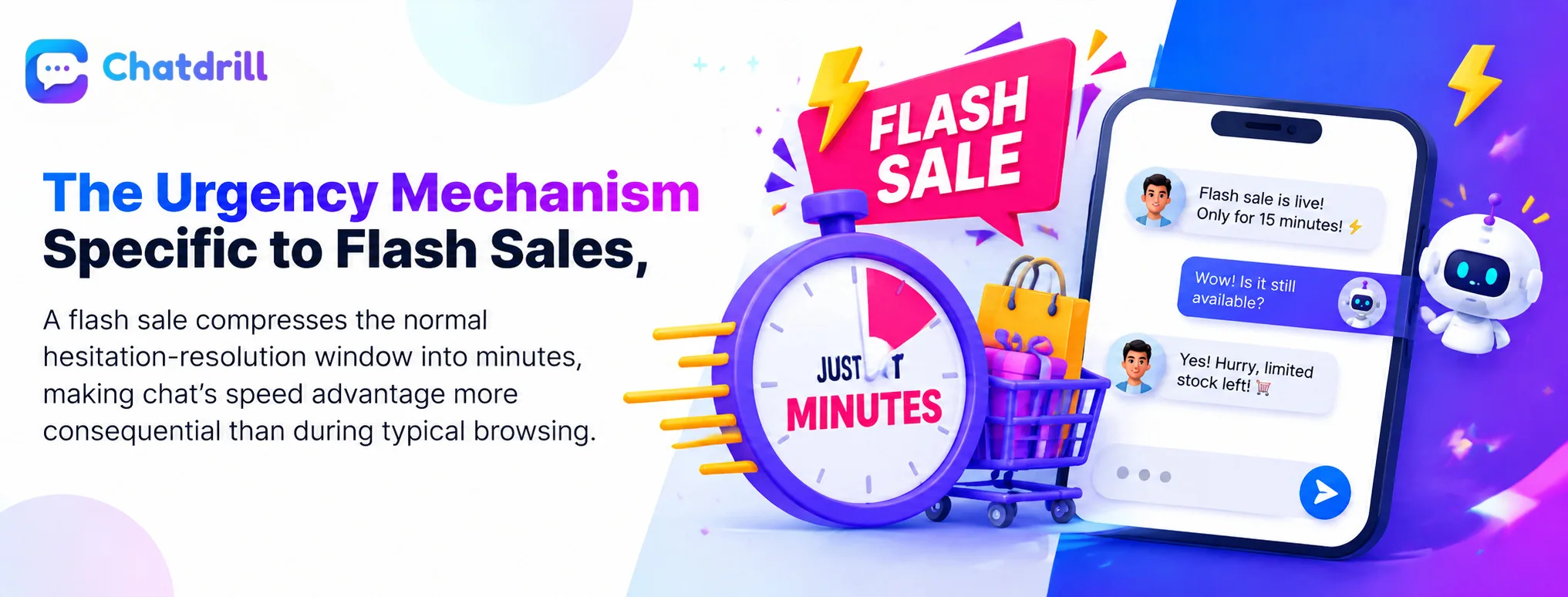
A flash sale compresses the normal hesitation-resolution window into minutes, making chat's speed advantage more consequential than during typical browsing.
Why the decision window shrinks dramatically
A flash sale's defining feature, genuine time pressure, means a hesitant customer typically has only minutes, not days, to get a question answered before the offer itself expires, a considerably shorter window than typical purchase consideration.
This compression means even a normally acceptable response delay becomes genuinely costly during a flash sale, since the customer may simply run out of time before ever getting an answer.
Chat's real-time nature is uniquely suited to this compressed window, since it's the only common channel capable of resolving a question within the genuinely narrow time a flash sale allows.
Why traffic volume and urgency compound together
A flash sale typically drives a genuine traffic spike at the same moment urgency is highest, meaning the exact period when fast response matters most is also the period when maintaining that speed is hardest without specific preparation.
This compounding effect is why flash sale preparation deserves distinct attention beyond generic, steady-state chat staffing and AI training.
Preparation Tactics for Flash Sale Periods
Pre-configuring AI with exact promotion terms and temporarily expanding capacity both directly address the urgency and volume this scenario creates.
Pre-configuring AI with exact promotion terms
Training your chat AI in advance with the precise, accurate terms of the specific promotion, exact discount, eligible items, expiration time, ensures instant, accurate answers to the exact questions a flash sale reliably generates.
This advance preparation matters especially given the genuine cost of a slow or inaccurate answer during a window where the customer may have no time to wait for a correction.
Temporarily expanding capacity for the campaign window
Planning temporarily expanded human staffing or AI concurrency settings specifically for the flash sale's compressed active window addresses the traffic-and-urgency compounding effect this guide identifies without requiring an ongoing capacity commitment.
This temporary scaling should specifically match the flash sale's actual duration, avoiding both underpreparation during the critical window and unnecessary sustained cost once the sale ends.
Common Mistakes During High-Stakes Campaigns
Failing to prepare AI with exact, current promotion details, and underestimating the traffic-urgency compounding effect, are the most common mistakes.
Inaccurate or outdated promotion information
Providing even a slightly inaccurate detail about a flash sale's specific terms, an expired discount code, an incorrect eligibility rule, can create genuine confusion and lost sales precisely when there's no time for a customer to seek clarification elsewhere.
Verifying that AI training reflects the exact, current promotion details, right up to the campaign's actual launch, prevents this specific, costly mistake.
Underestimating the traffic-urgency compounding effect
Applying only modest, incremental capacity adjustments for a flash sale, without accounting for how urgency and volume compound together during this specific scenario, risks the same response degradation this guide identifies as particularly costly during a compressed decision window.
Planning capacity specifically for the flash sale's genuine, anticipated peak, rather than a modest average increase, better protects against this compounding risk.
Measuring the Actual Campaign Chat Impact
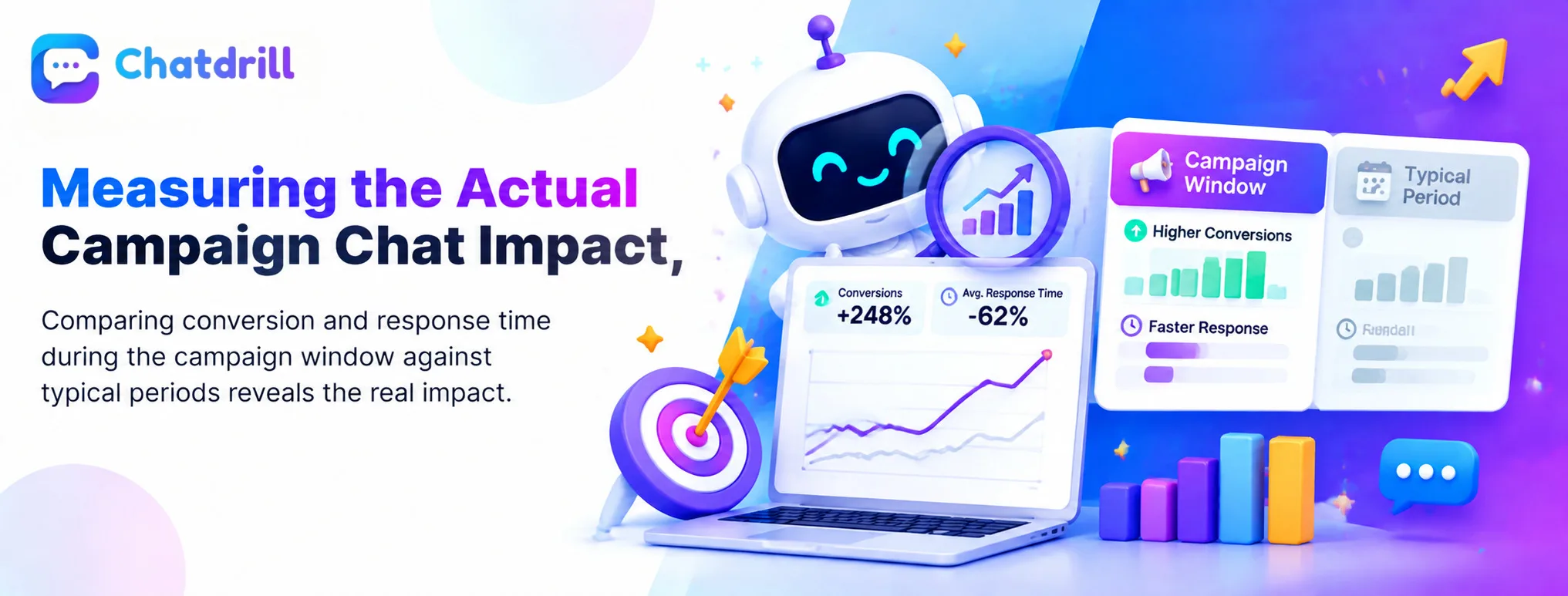
Comparing conversion and response time specifically during the campaign window against typical periods reveals whether preparation genuinely captured the available opportunity.
Comparing campaign-period conversion against typical periods
Tracking chat-assisted conversion specifically during the flash sale window, compared against a typical, non-promotional period, reveals whether chat's urgency-resolution role genuinely captured additional sales during this high-stakes window.
This comparison helps quantify chat's specific contribution to campaign revenue, informing how much future preparation investment is genuinely justified.
Reviewing response time specifically during peak campaign moments
Examining response time data specifically during the campaign's actual traffic peak, rather than an average across the full campaign period, reveals whether capacity preparation genuinely held up when it mattered most.
This peak-specific review often reveals a more accurate picture than a blended average, which can mask genuine degradation during the shortest, most critical peak moments.