
Content Tidio is a common first choice for small online stores, pairing live chat with AI chatbots for lead capture and cart recovery, but as order volume and catalog size grow, its automation and reporting depth often can't keep pace.
The gap tends to show up in specific ways: chatbots that need heavy manual configuration for anything beyond the basics, reporting that doesn't scale with a larger catalog, and integrations that stay narrowly ecommerce-focused rather than extending into broader CRM or marketing tools a growing brand increasingly relies on.
None of this makes Tidio a poor choice for a store just getting started, the question is what to move to once genuine growth exposes those limits, and how to make that decision without disrupting order support during the transition itself.
Store size is a useful lens for this decision too, a growing Shopify store, a brand juggling high email and chat volume, and a large enterprise ecommerce operation each tend to land on a different alternative for genuinely different reasons.
This guide covers what to look for in a Tidio alternative, the eight strongest options for ecommerce in 2026, how they fit different store sizes, a closer look at pricing, and what to plan for before switching.
Why Ecommerce Teams Look for Tidio Alternatives
Ecommerce teams look for Tidio alternatives once automation needs go beyond simple flows, reporting needs to cover a larger catalog, or a store needs deeper integration with order and customer data, especially as order volume climbs past what a small-store setup was ever designed to handle.
Simple overview
Tidio remains a solid starting point for a small store, but scaling order volume tends to expose the limits of its automation and reporting.
The transition point often coincides with a store adding a second sales channel, marketplace listings alongside a direct site, where Tidio's more basic reporting starts to feel insufficient for the added complexity.
This pattern holds across most ecommerce chat tools built for an SMB audience, not something specific to Tidio alone.
Where Tidio's automation depth runs out
Advanced workflows often require manual configuration, and AI chatbot depth is lighter than platforms built specifically around larger catalogs and order histories.
This shows up most clearly with product-specific questions, a chatbot that can't distinguish between SKUs or variants tends to give generic answers that frustrate shoppers on a store with real catalog depth.
Stores with a rapidly growing catalog tend to notice this limitation earliest, since the gap between what the chatbot can answer and what customers actually ask widens as SKU count grows.
What growing stores need instead
Growing stores generally want AI trained directly on product and order data, plus reporting that scales with a larger catalog and higher volume.
They also increasingly want that automation to tie into broader marketing and retention efforts, not just handle a support conversation in isolation from the rest of the customer relationship.
This broader integration need is often what ultimately triggers a switch, more than any single automation gap on its own.
Stores that map out this need clearly before evaluating alternatives tend to make a faster, more confident decision than those comparing platforms purely on feature checklists.
What to Look for in a Tidio Alternative for Ecommerce
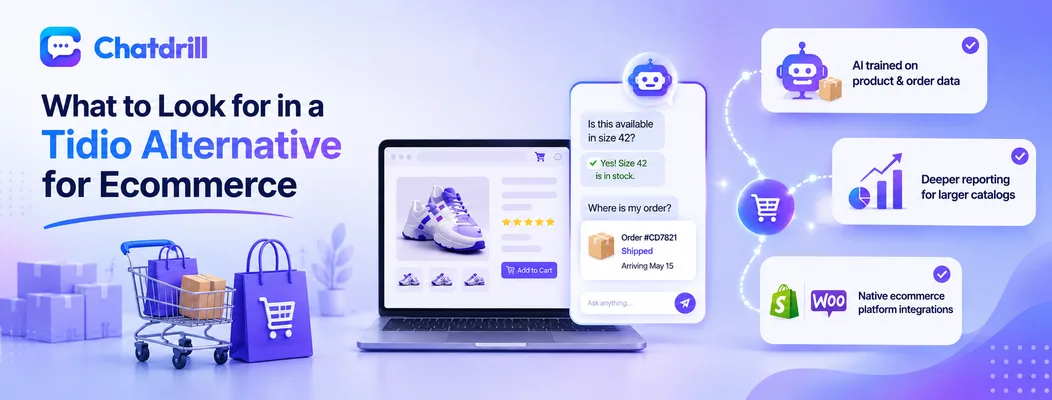
Content A strong Tidio alternative for ecommerce offers AI trained on product and order data, reporting that holds up at a larger catalog size, and native integrations with the ecommerce platform already in use.
AI trained on product and order data
Look for a chatbot that can answer specific product and order-status questions directly, not just generic FAQ-style responses.
Testing this before committing is straightforward, ask the AI a specific question about a real product or a past order during a trial, and see whether it responds with genuine detail or a generic deflection.
It's also worth testing a question involving a specific SKU or variant, since that level of specificity is often where a weaker chatbot's limitations become obvious.
Deeper reporting for larger catalogs
As SKU count and order volume grow, reporting needs to scale accordingly rather than staying at a basic, small-store level of detail.
It's worth checking specifically whether reporting can segment by product category or channel, not just show an aggregate across the entire store, since that segmentation is what actually drives decisions at scale.
Confirming whether reporting updates in real time or on a delay also matters more than it might seem, especially during a fast-moving sales event.
Native ecommerce platform integrations
Direct integration with Shopify, WooCommerce, or a similar platform avoids the manual work of connecting order data separately.
Beyond just connecting, it's worth confirming how real-time that integration is, a sync that updates order status every few hours is meaningfully less useful than one reflecting changes instantly during an active chat.
Testing the integration with a genuinely recent order during a trial is the most reliable way to confirm it behaves as described in practice.
It's also worth confirming whether the integration is officially maintained by the chat platform itself or a third party, since officially maintained integrations tend to stay reliable through platform updates.
The Best Tidio Alternatives for Ecommerce

ChatDrill leads for AI trained on product and order data, with Chatboq, Gorgias, Crisp, Smartsupp, Freshchat, Intercom, and LiveChat each fitting a more specific ecommerce need, spanning everything from a scaling Shopify store to a large multi-channel enterprise brand.
ChatDrill — best overall Tidio alternative
ChatDrill pairs live chat with AI trained on product and order data, able to answer shipping and product questions directly, plus reporting that tracks chat-to-sale conversion as a store scales.
Stores migrating from Tidio specifically for deeper automation tend to find the AI qualification layer the biggest upgrade, since it goes further than Tidio's flows in handling nuanced, multi-part product questions.
The plan-based pricing also tends to be more predictable than Tidio's volume-based model, particularly valuable heading into a high-traffic sales season.
Chatboq — best AI-first ecommerce alternative
Chatboq is purpose-built for ecommerce, unifying AI chatbot automation and live chat with a strong focus on sales conversion.
It shares ChatDrill's ecommerce focus closely, making the choice between the two often come down to specific integration needs or pricing at a given store's scale.
Both are worth trialing directly with real product and order questions before deciding, since the two platforms' AI can behave differently despite a similar overall focus.
Gorgias — best helpdesk built for Shopify
Gorgias is built specifically around Shopify and order data, offering deeper ecommerce-specific automation at a higher, ticket-volume-based price point.
For a Shopify store with high ticket volume specifically, Gorgias's deep native integration is hard to match, though the ticket-based pricing model is worth modeling carefully as volume grows.
Stores considering Gorgias should model their actual ticket volume carefully, since this pricing structure can grow expensive faster than a plan-based alternative at high volume.
Crisp — best for stores with high email volume
Crisp offers a broader, less ecommerce-specific feature set than Tidio, suited to stores that also handle significant email support.
This is the right fit specifically for a store where chat is only one of several support channels, rather than the primary one, since Crisp's unified inbox handles that mix more naturally than ecommerce-only tools.
Stores with a smaller catalog but a genuinely multi-channel support load tend to find this balance more useful than a narrower, ecommerce-only tool.
Smartsupp — best for visitor session recordings
Smartsupp adds visitor session recordings on top of live chat, giving insight into browsing behavior that Tidio doesn't offer.
This is a genuinely different value proposition than pure chat automation, worth choosing specifically when understanding on-site shopping behavior matters as much as the chat conversations themselves.
Stores optimizing their checkout flow specifically tend to find this visual insight more valuable than chat automation depth alone.
Freshchat — best for the Freshworks ecosystem
Freshchat suits stores planning to adopt the broader Freshworks suite, including Freshdesk for tickets, alongside chat.
As with other Freshworks products, the value here is tied to that broader ecosystem commitment rather than any standout ecommerce-specific feature on its own.
A store already committed to Freshdesk for support tickets will likely find the combined package more convenient than adopting a separate specialized ecommerce chat tool.
Intercom — best for large enterprise ecommerce
Intercom offers enterprise-grade AI automation, suited to larger stores that have outgrown SMB-focused tools like Tidio entirely.
This is the right move specifically once a store's support operation has genuinely outgrown SMB tooling altogether, though it comes with a meaningfully higher and less predictable cost structure.
Large brands with dedicated support operations teams tend to have the resources to manage that complexity productively, which smaller stores often don't.
LiveChat — best for reporting depth
LiveChat offers stronger reporting and a larger integration library than Tidio, at the cost of lighter AI automation.
Stores that value detailed agent-level reporting over deep AI automation specifically tend to find LiveChat a better fit than the more AI-forward alternatives on this list.
This trade-off is worth being explicit about during evaluation, since choosing LiveChat means accepting a lighter AI layer in exchange for stronger reporting depth.
Tidio Alternatives by Store Size
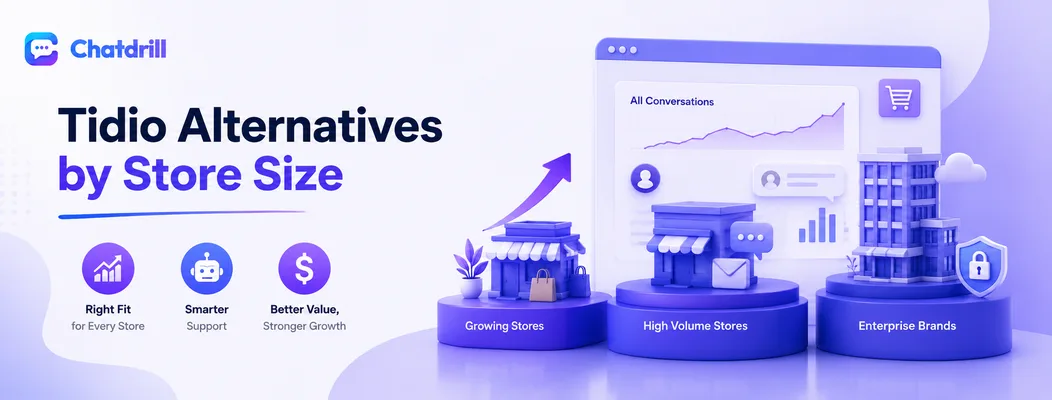
Growing Shopify stores fit best with ChatDrill, Chatboq, or Gorgias, stores with high email and chat volume fit Crisp or Freshchat, and large enterprise ecommerce brands fit Intercom or LiveChat.
Best for growing Shopify stores
ChatDrill, Chatboq, and Gorgias all offer deeper order-data awareness and AI training control suited to a scaling catalog.
Among the three, ChatDrill and Chatboq tend to be more cost-predictable for a mid-sized store, while Gorgias's ticket-based pricing suits a store with especially high support volume specifically.
Testing each with a store's actual product catalog during a trial remains the most reliable way to see which fits best in practice.
Best for stores with high email + chat volume
Crisp and Freshchat both offer a unified inbox across chat and email, not just an ecommerce-specific widget.
This matters most for a store where email remains a primary support channel alongside chat, rather than one where chat has effectively become the default way customers reach out.
Stores transitioning customers toward chat over time may eventually outgrow this need, worth revisiting the choice periodically as customer behavior shifts.
Best for large, enterprise ecommerce brands
Intercom and LiveChat offer the deepest reporting and AI training control for high-volume, enterprise-scale stores.
Both also tend to offer stronger compliance and security tooling that becomes relevant once a brand reaches a size where procurement and data governance enter the buying decision.
Brands at this scale typically have dedicated resources to manage the added complexity that comes with a more configurable, enterprise-oriented platform.
Best for stores selling across multiple channels
A store selling through its own site plus one or more marketplaces tends to benefit most from a platform with strong, centralized reporting that doesn't require piecing data together manually across channels.
ChatDrill and LiveChat both handle this reasonably well, though it's worth confirming during a trial that reporting genuinely consolidates across every channel a store actually sells through, not just the primary website.
What to Consider Before Switching From Tidio
Before switching, plan to rebuild chatbot flows on the new platform, confirm order and customer data context carries over, and verify the new tool integrates natively with your ecommerce platform.
Rebuilding chatbot flows
Existing chatbot flows typically need to be rebuilt rather than imported directly, so export your FAQ content first to speed up setup.
Reviewing which existing flows actually get used, rather than rebuilding every one that was ever created, is a good opportunity to trim flows that were rarely triggered in the first place.
This review often reveals which flows genuinely earn their place versus which were set up once and never revisited.
Exporting order and customer data context
Confirm how the new platform pulls in order history and customer context, since that's central to how well its AI can answer product and shipping questions.
It's worth testing this specifically with a handful of real past orders during a trial, rather than assuming the integration works as described, since the quality of that sync varies noticeably between platforms.
Confirming update frequency for this sync, not just its existence, matters especially for a store with frequent order status changes.
Confirming platform integrations
Verify native support for Shopify, WooCommerce, or whichever ecommerce platform is in use before committing to a switch.
Beyond the core platform, it's also worth checking integrations with any marketing or loyalty tools already in use, since losing that connection can quietly break workflows that don't involve chat directly at all.
Testing each integration during a trial period, rather than relying on a features page description alone, remains the safest way to confirm compatibility before committing.
Setting a specific cutover date, ideally outside a peak sales period, also helps keep the migration from dragging on longer than necessary.
Tidio Pricing vs Alternatives: A Closer Look
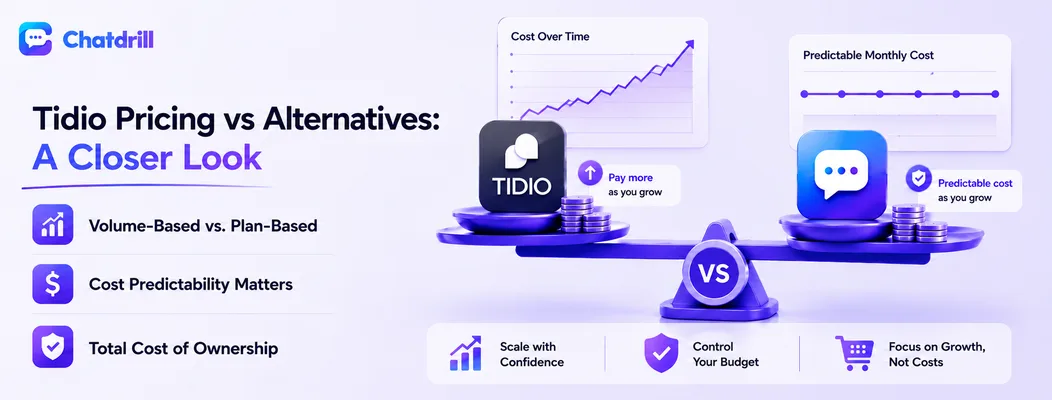
Tidio's pricing scales with both chatbot volume and contact count, which can make it harder to predict than a flat plan-based structure once a store's traffic and order volume start growing quickly.
How Tidio's pricing scales with chatbot and contact volume
Tidio's paid tiers are priced around the number of chatbot conversations and unique contacts reached, meaning cost climbs as a store's traffic grows, not just as features are added.
This structure rewards a smaller store well but can become harder to predict once traffic scales significantly during a busy season or a successful marketing push.
Stores running seasonal promotions in particular should model this carefully, since a successful campaign can unexpectedly push chatbot usage into a higher pricing tier mid-month.
Where ecommerce stores typically hit Tidio's limits
Stores commonly hit Tidio's limits when their chatbot conversation volume grows past what a given tier covers, triggering an upgrade, or when catalog complexity outpaces the chatbot's out-of-the-box product awareness.
This tends to happen gradually rather than as a sudden cutoff, worth watching for as a gradually rising bill rather than a single obvious moment.
Reviewing the monthly bill trend over several months, rather than a single invoice, tends to reveal this pattern earlier than waiting for a dramatic jump.
How ChatDrill's pricing compares at similar store sizes
ChatDrill's plan-based structure includes AI automation without a separate volume-based fee, which tends to produce a more predictable cost curve as a store's traffic and order volume grow.
At a comparable store size, this generally means fewer unexpected tier-upgrade moments compared to a volume-based pricing model like Tidio's.
This predictability is particularly valuable for a store planning its budget around known, fixed costs rather than variable ones tied to traffic.
How Gorgias and Chatboq compare on cost alone
Gorgias prices around ticket volume, which can grow expensive for a high-support-volume store; Chatboq's pricing is closer to ChatDrill's plan-based structure.
The right comparison depends heavily on a store's specific mix of chat versus ticket volume, worth modeling with real numbers rather than comparing sticker prices alone.
A store with mostly quick chat interactions and few formal tickets will likely find a plan-based model more cost-effective than a ticket-volume-based one.
What to ask any ecommerce chat vendor about pricing
Ask directly how pricing changes as chatbot conversation volume grows, and request a projection at your expected peak-season traffic, not just current average volume.
It's also worth asking whether pricing differs for AI-handled versus human-handled conversations, since that distinction affects the total cost of a store's automation strategy.
Requesting a specific worst-case cost scenario, based on a realistic traffic spike, helps avoid an unpleasant surprise during an actual busy season.
Calculating total cost of ownership for a growing store
Total cost of ownership should include projected peak-season volume, not just current average traffic, since a pricing model that looks affordable today may not stay that way during a busy period.
Factoring in the cost of any lost sales from a slower or less capable chat experience, not just the platform fee itself, gives a more complete picture of what a given choice actually costs.
This fuller calculation often changes the ranking between platforms compared to looking at the advertised entry-level price alone.