
tawk.to's fully free widget, unlimited agents, no cost, is hard to beat on price alone, but real AI automation, a modern interface, and removing tawk.to branding all sit behind paid add-ons, which is where "free" quietly stops being free.
That's not a criticism of tawk.to specifically, most free tools work this way, it's simply the point where a growing team's needs outgrow what a free plan was ever designed to cover.
The moment this becomes obvious is usually when a team totals up what it's actually paying tawk.to's add-ons for automation, chat detection removal, and reporting, and realizes that number is uncomfortably close to what a fuller, purpose-built platform would cost instead.
Once that comparison is made honestly, the decision often isn't really about tawk.to being bad, it's about recognizing that a business has genuinely outgrown a free tool's intended scope, and that continuing to patch it with add-ons is postponing a switch rather than avoiding it.
This guide covers what to look for once free stops being enough, the strongest alternatives in 2026, how they fit different priorities, a closer look at pricing specifically, and what to plan for before switching.
Why Teams Outgrow Tawk.to
Teams outgrow tawk.to once they need real AI automation, a more modern interface, or want to remove tawk.to branding, all of which sit behind paid add-ons rather than the free base plan.
Simple overview
tawk.to remains one of the only genuinely free live chat widgets, but that free tier was built for basic messaging, not AI-driven automation.
It's a genuinely reasonable choice for a business just getting started, the trade-off only becomes obvious once real automation or a more polished interface starts to matter.
This isn't a flaw specific to tawk.to, nearly every free tool in this category eventually reaches a similar ceiling as a business's needs grow more sophisticated.
What "free" doesn't include
AI automation, branding removal, and a more current interface all require paid add-ons, meaning the real cost of a fully featured setup isn't actually zero.
Stacking these add-ons together often surprises teams the first time they price them out individually, since each one is billed separately rather than as part of a single upgrade.
Reading the full pricing page carefully before relying heavily on tawk.to avoids this surprise arriving only after a team is already dependent on the platform.
The point most teams switch
The switch usually happens once a team realizes it would pay for tawk.to's add-ons anyway, and starts comparing that cost against an all-in-one paid platform instead.
This comparison tends to favor a dedicated paid platform more often than not, since the combined cost of tawk.to's add-ons frequently lands close to a competitor's base plan that already includes everything.
Recognizing this moment early, rather than continuing to add tawk.to add-ons piecemeal, tends to save both money and the hassle of a later, more disruptive switch.
What to Look for in a Tawk.to Alternative
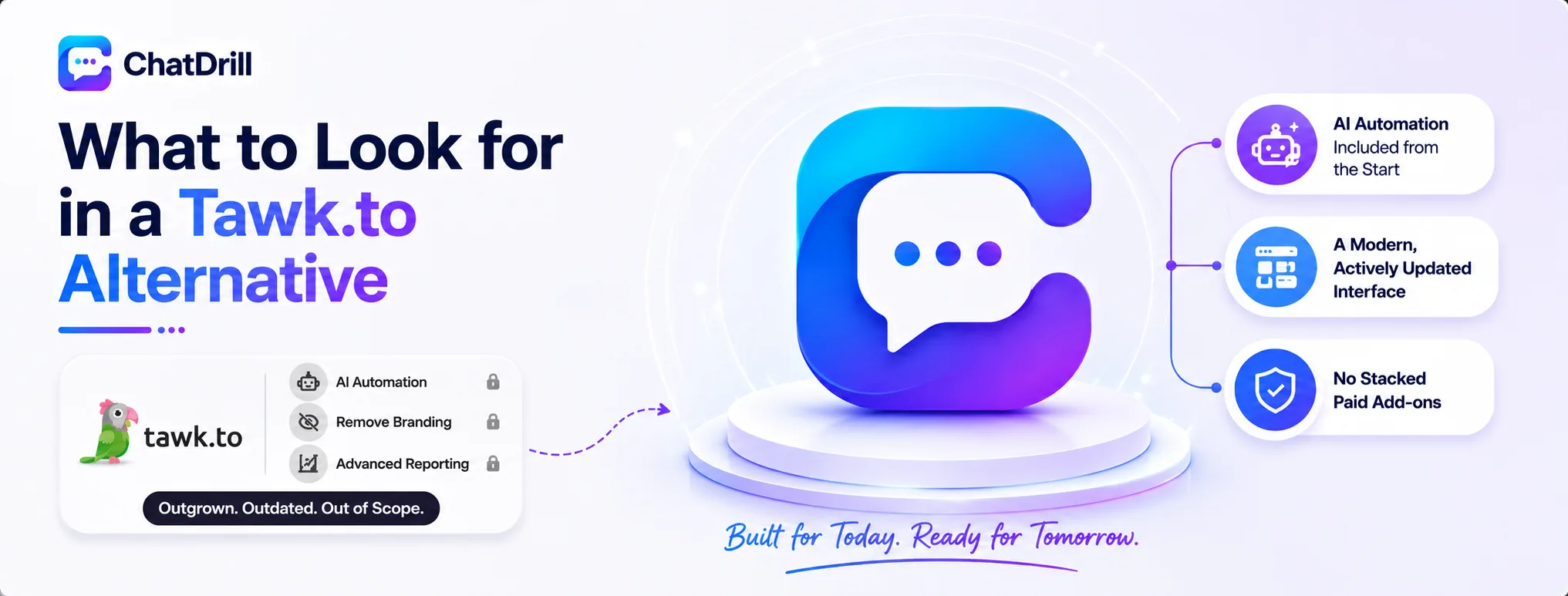
A strong tawk.to alternative includes AI automation from the start rather than as a paid add-on, offers a modern, actively updated interface, and avoids stacking multiple upsells just to reach basic functionality.
AI automation included from the start
Look for a platform where AI qualification and FAQ automation come standard in the core plan, not layered on as an extra purchase.
This single factor tends to explain most of the value gap between tawk.to and a paid alternative, since automation is exactly what tawk.to's free tier was never designed to include.
Testing this directly with real customer questions during a trial reveals whether a platform's AI genuinely performs well or is more of a marketing checkbox.
A modern, actively updated interface
An actively developed interface tends to mean faster feature releases and a better day-to-day experience for agents.
It's worth testing the interface directly during a trial rather than judging from screenshots, since day-to-day usability differences are often more noticeable in practice than they appear on a features page.
An interface that agents genuinely enjoy using tends to translate into faster, more consistent responses over time, a real if hard-to-measure benefit.
No stacked paid add-ons
A single, transparent plan avoids the pattern of needing to buy branding removal, automation, and reporting separately just to match what a modern platform includes by default.
Asking a vendor directly for a full list of what's included at the quoted price, rather than assuming it matches a demo, avoids discovering a needed feature is a separate purchase later.
A platform's pricing page is usually the clearest signal here, if it lists several optional add-ons prominently, that's worth factoring into the true cost comparison.
The Best Tawk.to Alternatives
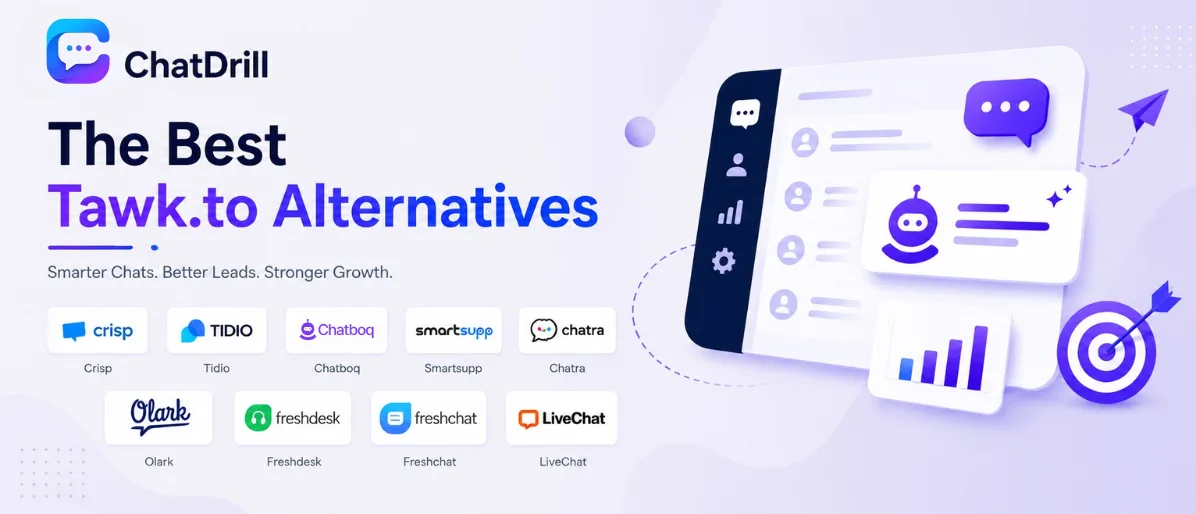
ChatDrill leads for AI automation included by default, with Crisp, Tidio, Chatboq, Smartsupp, Chatra, Olark, Freshchat, and LiveChat each fitting a more specific priority.
ChatDrill — best overall tawk.to alternative
ChatDrill includes AI chatbot automation, lead scoring, and a modern shared inbox in its core plans, the exact features tawk.to locks behind separate paid add-ons.
Teams making the jump from tawk.to tend to notice the interface difference immediately, alongside AI that actually qualifies conversations rather than just relaying messages to an agent.
The setup process is also fast enough that most teams report being fully operational within a day, minimizing the disruption of switching away from a tool they'd been using for free.
Crisp — best free tier with a modern interface
Crisp offers a genuinely free tier like tawk.to, but with a more current interface and a unified inbox across chat, email, and social.
For a team not yet ready to pay for AI depth, Crisp is a reasonable middle step between tawk.to and a fuller AI-first platform.
Its co-browsing feature is also a genuine differentiator, something tawk.to doesn't offer at any price point.
Tidio — best for basic AI chatbots
Tidio's free tier includes basic AI chatbots, a step up in automation from tawk.to's free plan.
Its ecommerce-specific automation in particular makes it a natural landing spot for a small store outgrowing tawk.to's simpler widget.
Teams specifically running an online store tend to find Tidio's product-aware chatbot noticeably more useful than tawk.to's generic messaging widget.
Chatboq — best AI-first ecommerce alternative
Chatboq trades tawk.to's free tier for AI automation built specifically around ecommerce lead capture and conversion.
For a store whose main goal is converting more chat conversations into sales, this narrower focus tends to outperform a general-purpose free widget.
Its checkout-assist and cart-recovery features are purpose-built in a way tawk.to's generic widget simply isn't.
Smartsupp — best for visitor recordings
Smartsupp offers a free tier plus visitor session recordings, a feature tawk.to doesn't provide at any price.
This is worth choosing specifically when understanding on-site visitor behavior matters as much as the chat conversations themselves.
Teams optimizing conversion funnels tend to get particular value from combining recordings with chat transcripts, spotting friction points neither data source reveals alone.
Chatra — best simple paid upgrade
Chatra keeps a similarly simple approach to tawk.to but with a more modern interface and light automation included.
It's a reasonable step up for a team that wants improvement without a large jump in platform complexity.
Teams that found tawk.to's interface dated but don't need heavy AI investment tend to find Chatra a comfortable middle ground.
Olark — best no-frills paid widget
Olark is a straightforward paid alternative for teams that want a reliable widget without free-tier limitations.
Teams that found tawk.to's free tier's limitations frustrating, but don't need heavy AI automation, tend to find Olark's simplicity a comfortable fit.
Its focus on doing one thing well, rather than bundling in ticketing or deep automation, appeals to a specific kind of small, focused team.
Freshchat — best for a fuller support ecosystem
Freshchat suits teams ready to move from a free widget into a fuller support ecosystem, including AI and ticketing.
Its value depends heavily on whether a team plans to also adopt other Freshworks products alongside chat.
For a team without that broader Freshworks interest, more chat-focused alternatives on this list tend to be a more direct fit.
LiveChat — best for deep reporting
LiveChat offers far deeper reporting and integrations than tawk.to, for teams ready to invest in a reporting-first platform.
This is the right move specifically for a team that has outgrown tawk.to's basic reporting and needs genuine visibility into team performance.
Its agent-level metrics in particular go well beyond what tawk.to's free analytics were ever designed to show.
Tawk.to Alternatives by Priority
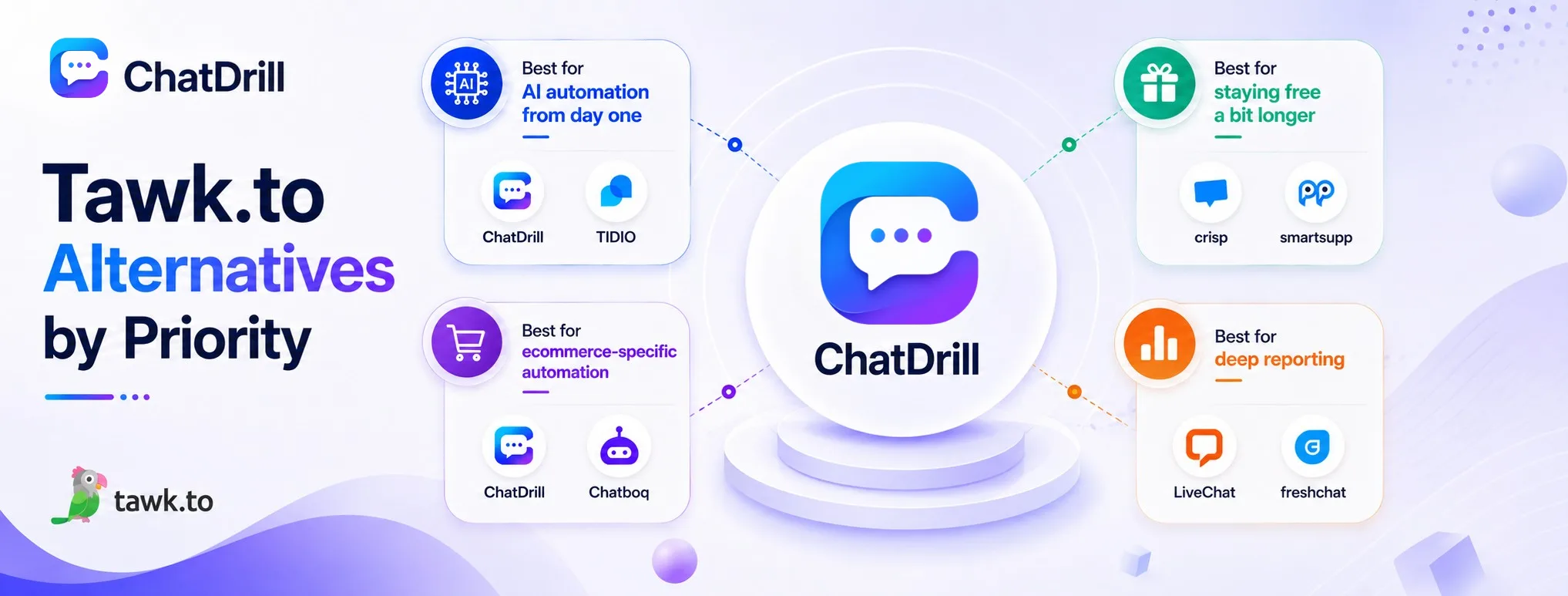
ChatDrill and Tidio suit teams wanting AI from day one, Crisp and Smartsupp suit teams wanting to stay free a bit longer, ChatDrill and Chatboq suit ecommerce-specific automation, and LiveChat suits teams prioritizing deep reporting.
Best for AI automation from day one
ChatDrill and Tidio both include real AI qualification without requiring a separate paid add-on the way tawk.to does.
Between the two, ChatDrill tends to suit a broader range of business types, while Tidio leans more specifically toward ecommerce.
Either choice removes the awkward middle step of paying for tawk.to's automation add-on while still not getting a fully modern experience.
Best for staying free a bit longer
Crisp and Smartsupp both offer a free tier with more modern features than tawk.to's base plan.
Either is a reasonable next step for a team not yet ready to pay, planning to reassess again once automation becomes a genuine priority.
Setting a specific trigger for that reassessment, like reaching a certain chat volume, keeps the decision from being indefinitely postponed.
Best for ecommerce-specific automation
ChatDrill and Chatboq both offer AI trained on product and order data.
This matters most for a store fielding a high volume of product and shipping questions that a generic chatbot can't answer well.
Testing both directly with real product questions during a trial is the clearest way to see which one's AI performs better for a specific catalog.
Best for deep reporting
LiveChat and Freshchat offer the most detailed analytics dashboards among tawk.to alternatives.
Teams prioritizing visibility into agent performance over AI depth tend to find either of these a stronger fit than the AI-first options on this list.
This trade-off is worth being explicit about, since neither platform matches ChatDrill's AI qualification depth in exchange for that reporting strength.
Tawk.to Pricing vs Alternatives: A Closer Look
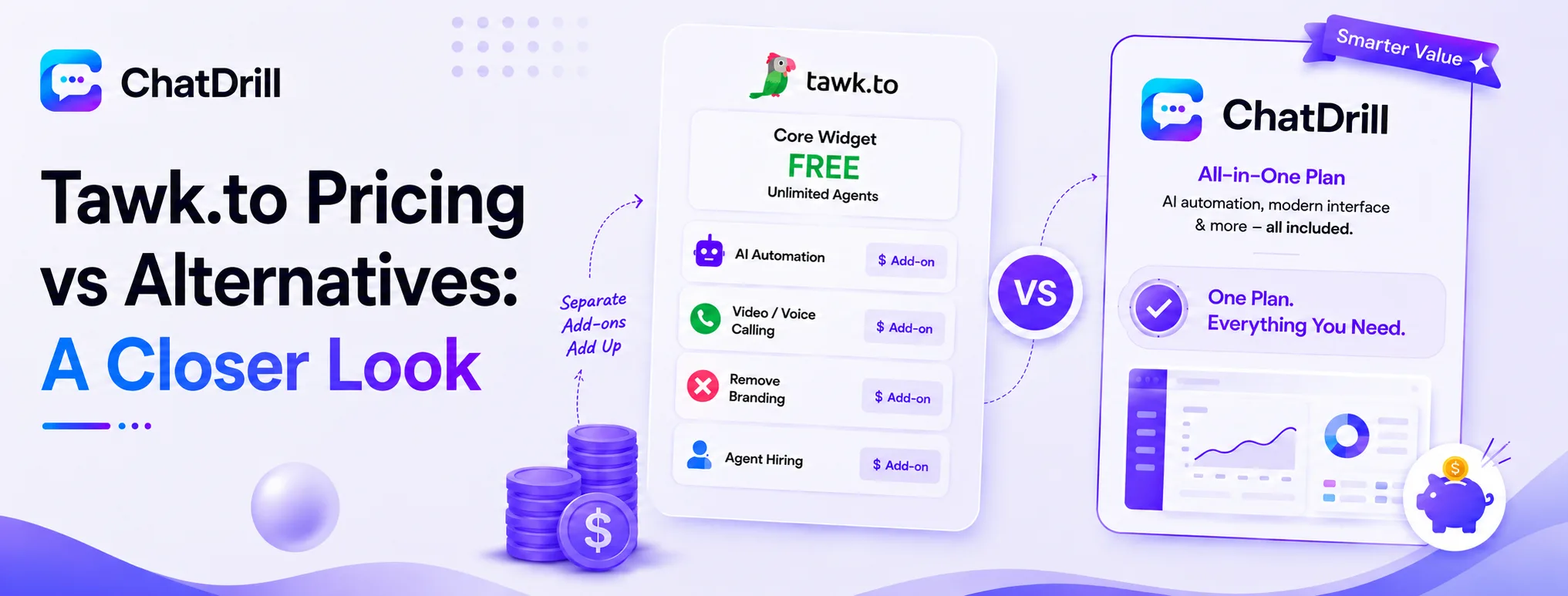
tawk.to's core widget is free, but AI automation, branding removal, and agent hiring functions are billed as separate add-ons, which is worth totaling up honestly before assuming tawk.to is the cheapest option available.
How tawk.to's free-plus-add-ons model works
The base widget and unlimited agents are free, while AI automation, video/voice calling, and removing the tawk.to badge are each billed as separate monthly add-ons.
Once two or three of these add-ons are combined, the total monthly cost can approach what a fuller paid platform charges for everything included.
This a la carte pricing structure means the actual cost depends entirely on which features a specific team ends up needing, making a blanket claim of "free" somewhat misleading in practice.
Where the true cost hides
The true cost hides in the gap between what a team assumes is free and what it actually ends up paying for once automation and branding removal are added.
Teams that skip this calculation often don't realize how much they're spending until they compare their actual monthly tawk.to bill against a competitor's advertised base price.
Reviewing the actual monthly invoice, rather than the marketing page's headline "free" claim, is the only reliable way to know the real cost of a fully featured setup.
How ChatDrill's pricing compares
ChatDrill's plan-based pricing includes AI automation and a modern interface without needing to add anything separately, which tends to produce a lower total cost once tawk.to's add-ons are factored in.
This also simplifies budgeting, since there's one predictable line item instead of several add-ons that could each change price independently.
Teams that have already added two or more tawk.to add-ons often find the comparison tips clearly in ChatDrill's favor once the full picture is laid out.
How Crisp and Tidio compare on cost
Crisp and Tidio both offer competitive free tiers, though with narrower AI capability than tawk.to plus its automation add-on combined.
For a team specifically prioritizing cost over automation depth, either remains a reasonable choice worth testing directly.
Neither fully matches ChatDrill's AI qualification depth at a comparable price point, worth weighing directly against how much automation a team genuinely needs.
What to ask before adding another tawk.to add-on
Before purchasing another tawk.to add-on, it's worth pricing out what a competitor's all-inclusive plan would cost for the same combined feature set.
This single comparison often reveals that staying on tawk.to with add-ons isn't actually the cost-saving choice it initially appears to be.
It's also worth asking whether the add-on being considered is likely to be the last one needed, or the first of several more down the line.
Calculating true total cost before deciding
Total cost should include every add-on a team currently uses or plans to use soon, not just the free base widget's advertised price.
Running this calculation honestly, ideally before renewing any add-on, is the clearest way to know whether staying on tawk.to still makes financial sense.
Revisiting this calculation every six months or so, as needs evolve, keeps the decision current rather than relying on an assessment made a year or more ago.
What to Consider Before Switching From Tawk.to
Before switching, export existing chat history, budget realistically for a paid platform instead of stacking tawk.to add-ons, and test the AI on real conversations before fully committing.
Exporting chat history
tawk.to supports exporting chat transcripts, so check the new platform's import options to preserve that history before switching.
Running a small test export and import first catches any formatting issues before committing to a full migration.
Keeping a local backup of the export outside both platforms during the transition is a simple precaution worth taking.
Budgeting for a paid platform
Compare the true cost of tawk.to plus its add-ons against a single paid platform, since the free tier rarely stays free once real automation is needed.
This budgeting exercise is also a good moment to project cost forward at a larger team size, not just today's headcount.
Presenting this comparison clearly to whoever approves the budget tends to make the case for switching more compelling than a vague sense that tawk.to feels limited.
Testing AI before committing
Run a trial with real, typical customer questions to confirm the AI actually performs well before fully migrating away from tawk.to.
Testing with a handful of genuinely tricky questions, not just simple ones, gives a much better sense of how the AI will perform once live.
This testing phase is worth doing thoroughly, since it's far easier to catch AI gaps during a trial than after a full migration is already underway.