


Product feedback collected through a dedicated survey typically suffers from low response rates and a self-selected respondent pool, while feedback embedded naturally within chat conversations captures a genuinely broader, more representative slice of your actual customer base.
Quick answer: Live chat collects product feedback at scale by capturing genuine customer opinions in the natural flow of a support or sales conversation, rather than relying solely on a separate survey most customers ignore, and by letting AI systematically tag and aggregate this feedback across thousands of conversations a manual review process could never keep up with.
The core opportunity is that customers already share opinions and reactions constantly within routine support and sales conversations, feedback that mostly goes uncaptured unless a system exists specifically to notice and aggregate it.
Understanding how to capture this naturally occurring feedback systematically, rather than only through separate, deliberate feedback requests, unlocks a genuinely larger and more representative data source than most businesses currently tap.
This guide covers the mechanism behind chat-based feedback collection, specific tactics for capturing it naturally, common mistakes, turning feedback into action, and how ChatDrill supports feedback collection at scale.
The Mechanism Behind Chat-Based Feedback Collection

Chat captures feedback both passively, through natural conversation content, and actively, through brief, well-timed questions embedded within an existing interaction.
Passive feedback within natural conversation
A customer explaining why they're frustrated with a specific feature, or praising something that worked particularly well, is genuinely valuable product feedback that occurs naturally within countless routine support conversations, whether or not anyone specifically asked for it.
AI-assisted analysis can systematically identify and tag this passive feedback across a large volume of conversations, surfacing patterns a manual review process simply couldn't keep pace with at scale.
This passive capture approach reaches customers who would never proactively respond to a separate survey, meaningfully broadening your feedback pool beyond the self-selected group who typically do respond.
Active, well-timed feedback questions
Asking a brief, specific feedback question at a natural point in an already-happening conversation, right after resolving an issue, for instance, captures a response rate considerably higher than a separate, standalone survey request sent later.
This higher response rate reflects the lower effort involved in answering one relevant question already within an active conversation, compared to the additional effort required to engage with a separate survey.
Specific Tactics for Capturing Feedback Naturally
Training AI to recognize feedback-relevant language and asking one specific, well-timed question after resolution both improve genuine feedback capture.
Training AI to recognize feedback-relevant language
Configuring your chat AI to flag conversations containing genuine opinion language, praise, frustration, feature requests, ensures this passive feedback gets systematically captured rather than disappearing into an unreviewed conversation archive.
This recognition capability turns your entire conversation history into a searchable feedback resource, rather than requiring customers to separately articulate feedback outside their natural conversation flow.
Asking one specific question after resolution
Following a successfully resolved conversation with one brief, specific question, "was there anything about [feature] that felt confusing?" rather than a generic "how did we do?", produces more genuinely useful, actionable responses.
This specificity principle mirrors the broader chat-effectiveness pattern of concrete, well-targeted questions outperforming vague, open-ended ones across many different chat contexts.
Common Mistakes in Chat-Based Feedback Collection
Asking for feedback at the wrong moment in a conversation, and failing to actually act on collected feedback, both undermine the value of this collection effort.
Asking for feedback at the wrong moment
Requesting feedback in the middle of an unresolved, ongoing issue, rather than after genuine resolution, produces responses colored by current frustration rather than a genuine, considered reflection on the product itself.
Timing the feedback request specifically after resolution, as this guide's tactics recommend, produces more genuinely useful, representative responses.
Collecting feedback without acting on it
Gathering substantial feedback through chat, but never systematically reviewing or acting on the patterns it reveals, wastes the genuine effort involved in collection and can eventually reduce customer willingness to keep providing it.
Building a genuine, ongoing review and action process, rather than treating feedback collection as an end in itself, ensures the effort translates into real product improvement.
Turning Collected Feedback Into Genuine Product Action
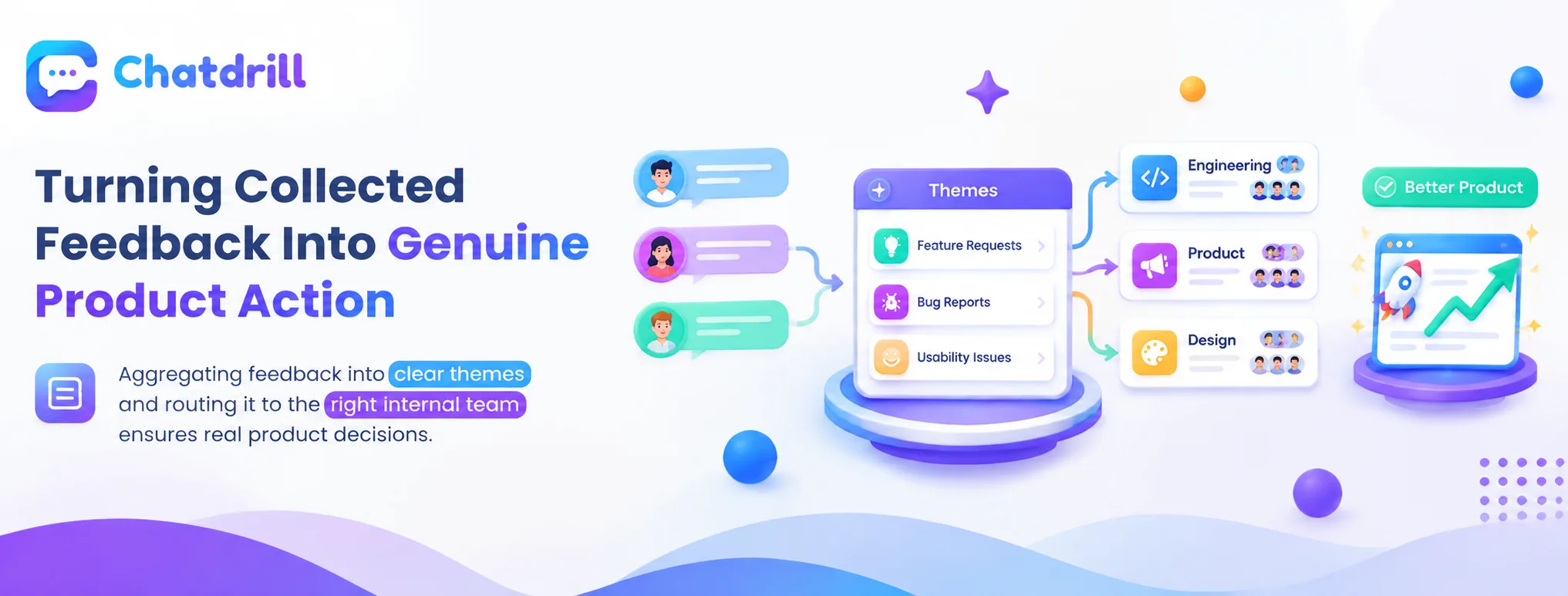
Aggregating feedback into clear themes and routing it to the right internal team consistently ensures collected feedback actually influences product decisions.
Aggregating feedback into clear, actionable themes
Reviewing collected feedback for recurring themes, rather than treating each individual comment in isolation, reveals genuine patterns worth prioritizing over a single, potentially unrepresentative opinion.
This thematic aggregation transforms scattered individual comments into a genuinely useful, prioritized input for product planning discussions.
Routing feedback to the right internal team
Establishing a clear, consistent process for getting aggregated feedback themes in front of the specific product or engineering team responsible for that area ensures the feedback genuinely reaches decision-makers rather than remaining buried in a support archive.
This routing discipline is what actually closes the loop between customer voice and product change, the ultimate goal of any feedback collection effort.