
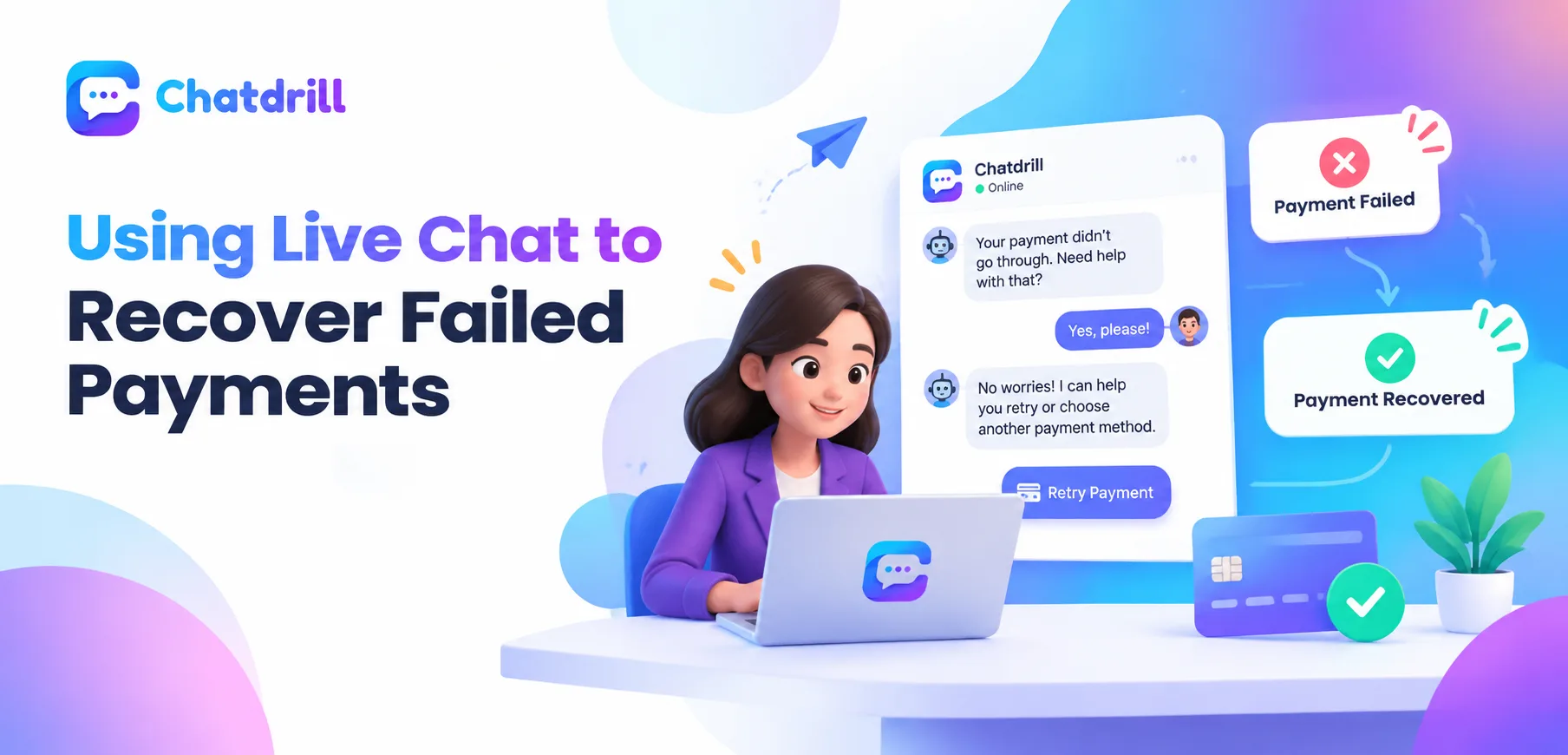
A failed payment often has nothing to do with a customer's actual satisfaction or intent to continue, an expired card, a bank's routine fraud flag, a temporary balance issue, yet if unaddressed, it can quietly turn into an unintended cancellation.
Quick answer: Live chat recovers failed payments by proactively reaching out the moment a payment fails with a clear, low-friction way to update billing details, rather than relying solely on an easily-missed automated email, since many failed payments stem from a simply outdated card rather than genuine customer disengagement.
Live chat offers a considerably more direct, immediate recovery path than the automated email most billing systems default to, an email that's genuinely easy to miss or dismiss compared to a real-time, personal conversation.
Understanding the specific reasons behind most payment failures, and the chat tactics that address them most effectively, helps a business recover revenue that would otherwise be lost to a fixable, non-intentional payment issue.
This guide covers the recovery mechanism, specific outreach tactics, common mistakes, measuring recovery effectiveness, and how ChatDrill supports failed payment recovery.
The Mechanism Behind Chat-Based Payment Recovery
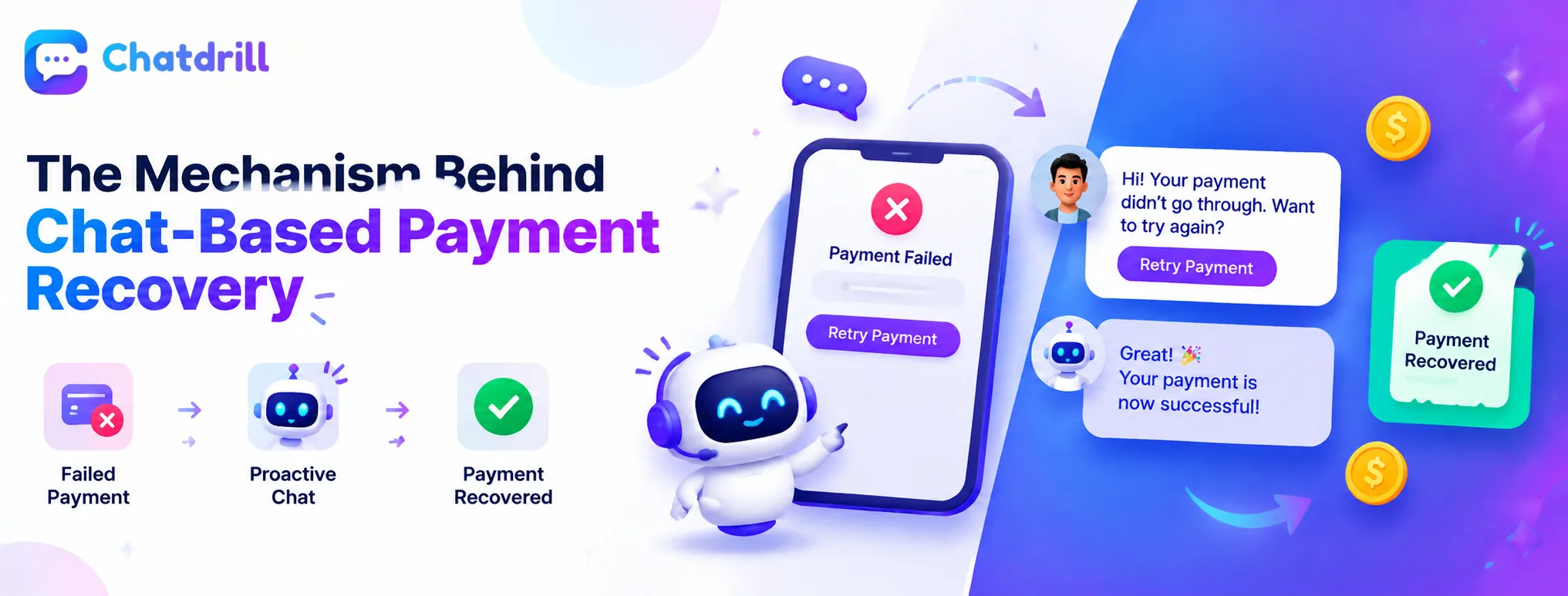
Chat recovers failed payments by reaching customers proactively and immediately, addressing an often simple, fixable issue before it silently becomes an unintended cancellation.
Why most failed payments are genuinely fixable
The majority of failed payments stem from a simple, correctable issue, an expired card, an updated billing address, a temporary bank-side flag, rather than any genuine change in the customer's desire to continue their subscription or purchase.
This fixability is precisely what makes proactive chat outreach so valuable, since the underlying problem usually just needs the customer's brief attention, not a genuine win-back or retention conversation.
Recognizing this distinction, a payment problem rather than a satisfaction problem, shapes the appropriate tone for outreach, straightforward and helpful rather than a more elaborate retention pitch.
Why immediate, personal outreach outperforms automated email
An automated payment-failure email competes with a full inbox and is easy to miss, dismiss, or simply forget to act on, while a proactive chat message feels more immediate and personal, prompting faster genuine action.
This immediacy matters because the longer a failed payment goes unaddressed, the more likely a subscription actually lapses or an order genuinely cancels, turning a fixable issue into a real, lost outcome.
Specific Outreach Tactics for Payment Recovery
Reaching out promptly with a clear, low-friction billing update path, and offering direct help if the customer seems stuck, both improve recovery rates.
Prompt, clear outreach with a direct update path
"Hi, it looks like your last payment didn't go through, likely just an expired card. Want to update it now? It only takes a moment." addresses the issue directly and provides an immediate, low-friction path to resolution.
This directness respects that most customers, once alerted, genuinely want to fix the issue quickly rather than needing extensive persuasion, making a clear, fast path more valuable than an elaborate explanation.
Offering direct help if the customer seems stuck
"I can walk you through updating your card details right here if that's easier." offers genuine, immediate assistance for a customer who might otherwise abandon the update process partway through if left to navigate it alone.
This offer respects that even a simple update process can create friction for some customers, and removing that friction directly through chat assistance improves overall recovery completion rates.
Common Mistakes in Payment Recovery Outreach
Treating a failed payment like a retention or win-back conversation, and delaying outreach too long after the failure, both reduce recovery effectiveness.
Treating it like a retention conversation
Approaching a failed-payment outreach with an elaborate retention pitch, discussing value and asking about satisfaction, when the customer likely just has an expired card, misreads the situation and adds unnecessary friction to what should be a quick, simple fix.
Matching the tone to the genuine, likely cause, straightforward and helpful rather than persuasive, produces a faster, less awkward recovery experience.
Delaying outreach too long after the failure
Waiting several days to reach out after a payment failure increases the risk that a subscription has already formally lapsed or an order has already canceled by the time the customer engages, missing the genuine recovery window.
Configuring chat outreach to trigger promptly, ideally within hours of the actual failure, captures the recovery opportunity while it's still genuinely available.
Measuring Payment Recovery Effectiveness
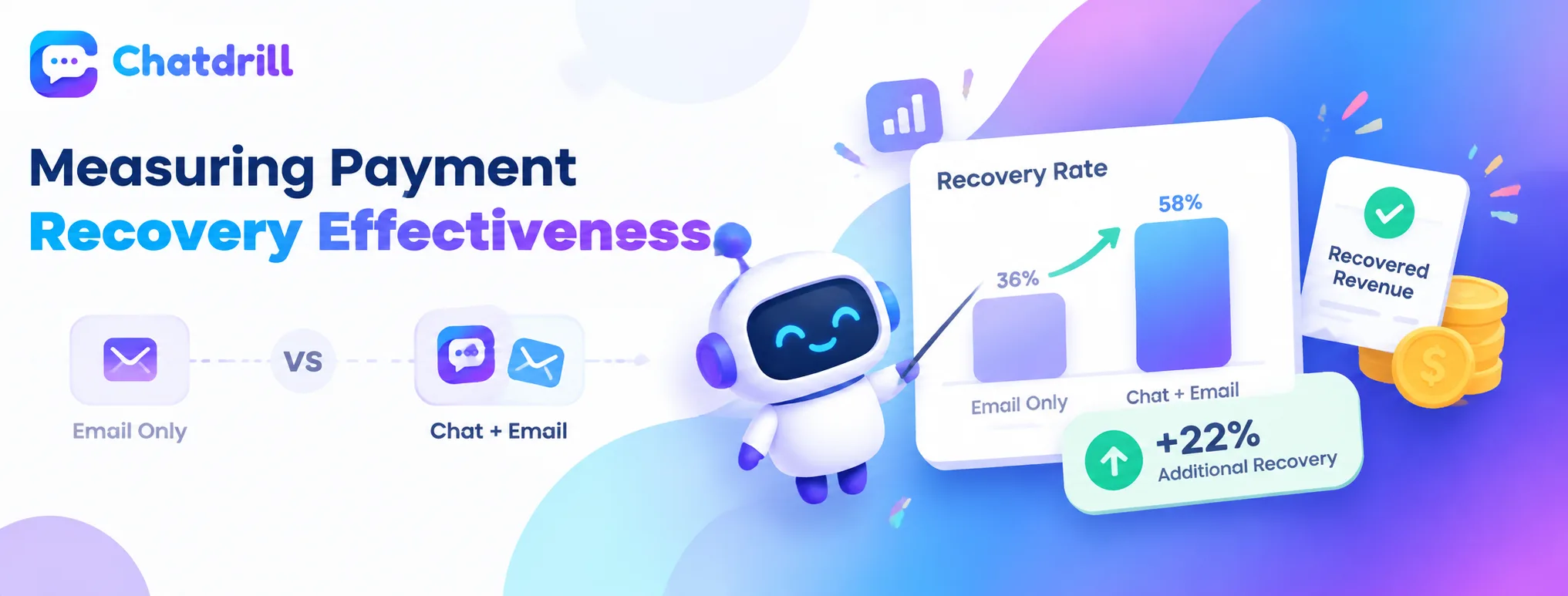
Comparing chat versus email-only recovery rates
reveals chat's genuine, additional contribution to recovered revenue.
Comparing chat versus email-only recovery rates Tracking what percentage of failed payments get successfully recovered through chat outreach, compared against your prior email-only baseline, provides direct evidence of chat's incremental contribution to recovery.
This comparison should track the same time window and failure-reason mix where possible, ensuring a fair, genuine comparison between the two recovery approaches.
Tracking recovery speed alongside overall rate
Measuring how quickly a payment gets updated after outreach, not just whether it eventually gets updated, reveals whether chat's immediacy advantage is genuinely translating into faster resolution, not just a marginally higher eventual rate.
This speed dimension matters because faster recovery reduces the window during which a subscription or order remains genuinely at risk of formal lapse or cancellation.