
Program Beta and early-access users occupy a genuinely distinct role compared to typical customers, they've opted into a rougher, less polished experience specifically because they're interested in providing feedback and helping shape the product's direction.
Quick answer: Live chat supports a beta or early-access program by giving genuinely engaged early users a direct, immediate channel to report issues and ask questions about an inherently rougher, less-documented product experience, while systematically capturing this feedback to inform the product's continued development before wider release.
Live chat serves this population particularly well, since beta users frequently encounter genuine confusion or bugs a more mature, documented product wouldn't create, and immediate access to help respects both their time and their genuine investment in the program's success.
Understanding how to support this specific user population effectively, distinct from typical customer support, helps a business extract maximum genuine value from a beta program while keeping early users genuinely engaged rather than frustrated.
This guide covers the distinct support needs of beta users, specific tactics for effective beta support, common mistakes, measuring the program's chat-supported success, and how ChatDrill supports beta and early-access programs.
The Distinct Support Needs of Beta Users
Immediate help with genuinely rough, undocumented edges
A beta product inherently includes rough edges, incomplete documentation, and genuine bugs a mature product wouldn't have, meaning beta users encounter confusion at a considerably higher rate than typical customers using a fully polished product.
Live chat's immediate availability respects that a beta user encountering this kind of genuine confusion, without the benefit of comprehensive documentation to self-serve an answer, needs faster, more direct help than a typical support scenario might require.
This immediate support also protects the beta program's own success, since a frustrated, unsupported beta user is considerably more likely to disengage from the program entirely rather than continuing to provide the valuable feedback the program depends on.
Beta engagement as valuable product feedback
Every chat interaction with a beta user, questions asked, confusion expressed, bugs reported, represents genuinely valuable product feedback distinct from typical support volume, since these users are specifically testing and evaluating a still-developing product.
Treating these interactions as a genuine feedback source, not just routine support tickets to close, captures additional value beyond the immediate help provided.
Specific Tactics for Effective Beta Support
Being transparent about the product's beta status and systematically capturing bug reports and feedback both improve the beta support experience and its genuine value.
Being transparent about beta status and limitations
Acknowledging openly when a reported issue reflects a known beta limitation, rather than treating every question as if the product were fully mature, sets appropriate expectations and avoids frustrating a beta user with an overly formal, mature-product-style resolution process.
This transparency also builds genuine trust with beta participants, who generally understand and accept a rougher experience as long as the business is honest about it rather than pretending the product is more polished than it actually is.
Systematically capturing bug reports and feedback
Configuring chat to systematically tag and route genuine bug reports or feature feedback to the product and engineering teams ensures this valuable beta-specific input reaches the people who can actually act on it, rather than being resolved conversationally and then lost.
This systematic capture transforms routine beta support interactions into a genuinely structured feedback pipeline, maximizing the program's overall value beyond just individual issue resolution.
Common Mistakes in Beta Program Support
Treating beta support identically to mature-product support, and failing to route captured feedback to the product team, both waste the program's genuine potential.
Treating beta support identically to mature-product support
Applying the same tone, expectations, and resolution processes used for a fully mature product to beta support misses the opportunity for the more transparent, collaborative relationship beta users generally expect and appreciate.
Adjusting tone and process specifically for the beta context, as this guide's tactics recommend, produces a genuinely better experience for this specific, distinct user population.
Failing to route captured feedback to the product team
Resolving a beta user's reported bug or confusion conversationally, without also ensuring that information reaches the product or engineering team, wastes the genuine feedback value this specific interaction represents.
Building the systematic routing process this guide recommends ensures beta support interactions genuinely contribute to product improvement, not just individual issue resolution.
Measuring the Beta Program's Chat-Supported Success
Tracking genuine bug and feedback volume through chat
volume reveals whether chat support is contributing to overall program success.
Tracking beta user engagement and retention
Monitoring whether beta users who engage with chat support remain more actively engaged with the program over time than those who don't reveals chat's genuine contribution to keeping beta participants involved and providing ongoing feedback.
This engagement tracking helps justify the specific investment in dedicated, well-designed beta support as a genuine contributor to overall program success, not just a routine support cost.
Tracking genuine bug and feedback volume through chat
Measuring the volume and quality of bug reports and feature feedback captured specifically through chat interactions quantifies this channel's genuine contribution to the product's development process during the beta period.
This tracking also helps demonstrate the systematic feedback-capture value this guide identifies, beyond chat's more immediately visible role in resolving individual beta user confusion.
How ChatDrill Supports Beta and Early-Access Programs
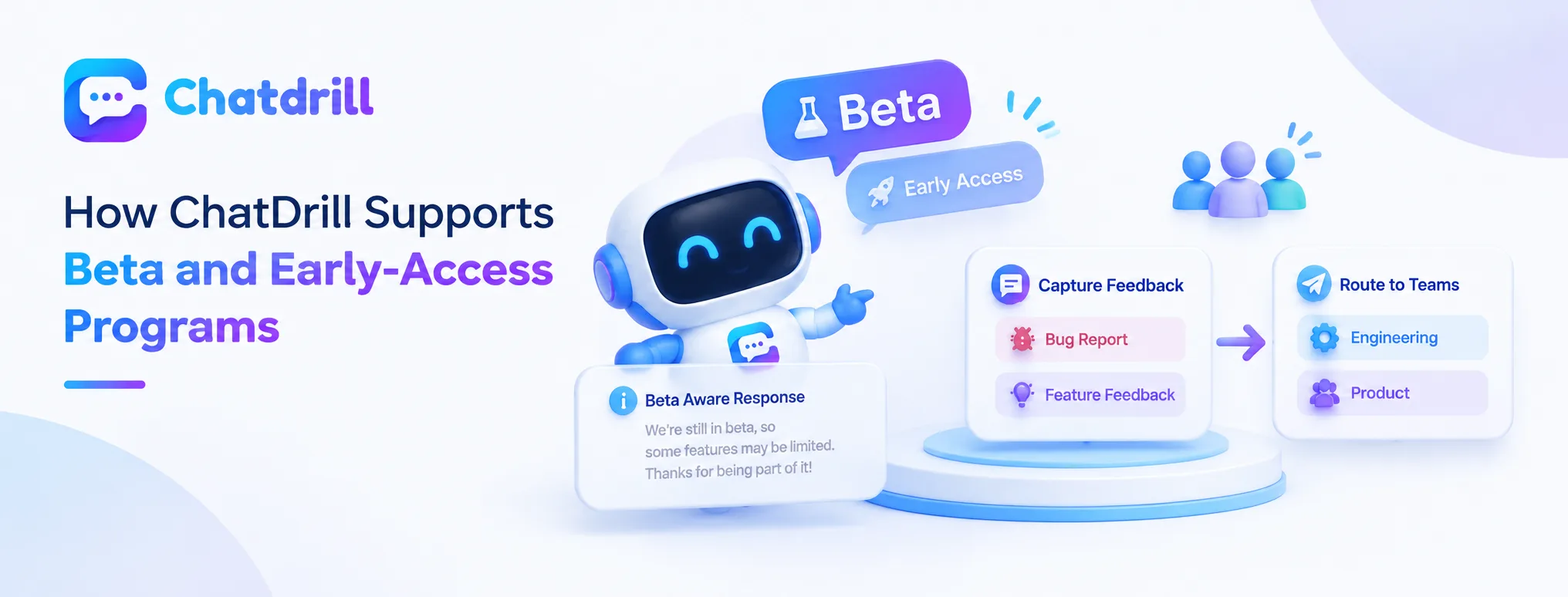
ChatDrill can be configured with appropriate transparency and systematic feedback capture, reflecting the distinct support needs this guide identifies for beta and early-access users.
Appropriately transparent, beta-aware responses
ChatDrill's AI can be trained to acknowledge known beta limitations transparently, reflecting the honest, expectation-setting approach this guide identifies as building trust with beta participants.
This beta-aware tone helps avoid the mismatch this guide warns against, applying mature-product-style formality to a population that generally expects and appreciates a more transparent, collaborative relationship.
Systematic capture and routing of beta feedback
ChatDrill supports tagging and routing genuine bug reports or feature feedback captured through beta support conversations directly to responsible product or engineering teams, reflecting the systematic capture this guide identifies as essential for maximizing program value.
This capability ensures beta support interactions contribute genuinely to product development, not just individual issue resolution, capturing the full value this guide identifies in a well-supported beta program.