
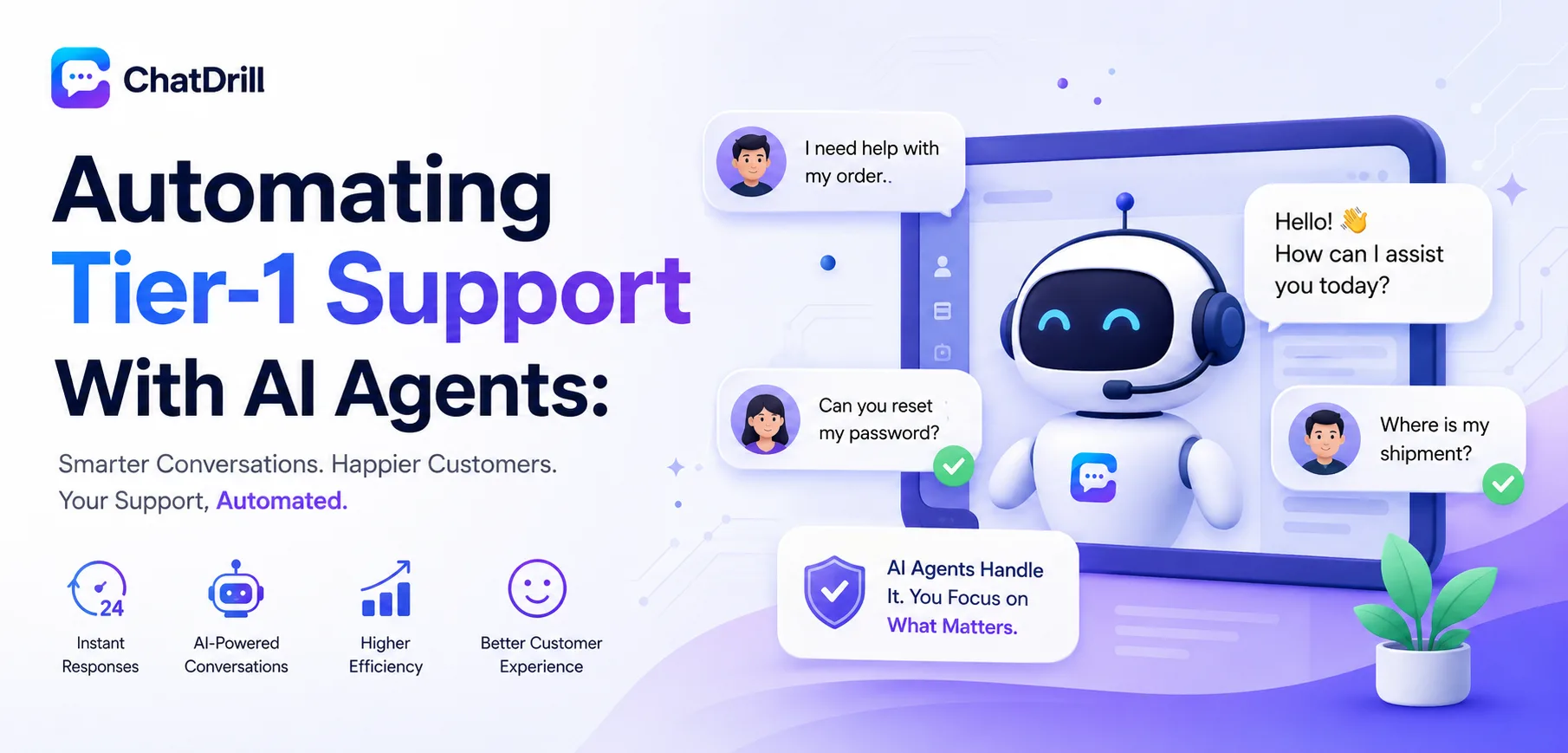
Tier-1 support, the first line of customer contact handling routine, well-defined questions, is consistently the best place to start automating with AI agents, since these conversations tend to be repetitive, predictable, and don't require the nuanced judgment more complex issues demand.
This isn't about replacing human support entirely, it's about letting AI absorb the repetitive volume so human agents can focus on tier-2 and tier-3 issues genuinely requiring their judgment, experience, and problem-solving ability.
Businesses that automate tier-1 well typically see meaningful gains, faster resolution for routine questions, more available human capacity for complex issues, and support coverage that extends beyond standard business hours.
Getting this right requires clearly defining what actually counts as tier-1 for your specific business, since the boundary varies, and building AI capability that genuinely handles that defined scope well rather than attempting more than it reliably can.
This guide covers what counts as tier-1 support, why it's the right starting point for AI automation, what AI agents can realistically handle at this level, a step-by-step approach to automating your tier-1 queue, how to measure success, and how ChatDrill supports this specifically.
What Counts as Tier-1 Support
Tier-1 support covers the first line of customer contact, typically routine, well-defined questions like order status, basic account information, and common how-to questions that don't require specialized troubleshooting or judgment.
Simple definition
Tier-1 issues are characterized by being common, repetitive, and having a clear, consistent correct answer, distinguishing them from tier-2 issues requiring genuine investigation or tier-3 issues needing specialized expertise.
The exact boundary of what counts as tier-1 varies by business, but the underlying pattern, high frequency, low complexity, well-defined resolution, remains consistent across most support operations.
Reviewing your own support volume against this pattern helps identify what genuinely belongs in your specific tier-1 category, rather than assuming a generic industry definition applies exactly.
Why this category exists as a distinct tier
Structuring support into tiers lets a business match question complexity to appropriate resources, routine questions to fast, efficient handling, and genuinely complex issues to agents with the specific expertise needed.
This structure existed well before AI automation became common, AI simply provides a new, highly efficient way to handle the tier-1 layer specifically.
Why Tier-1 Is the Right Place to Start With AI
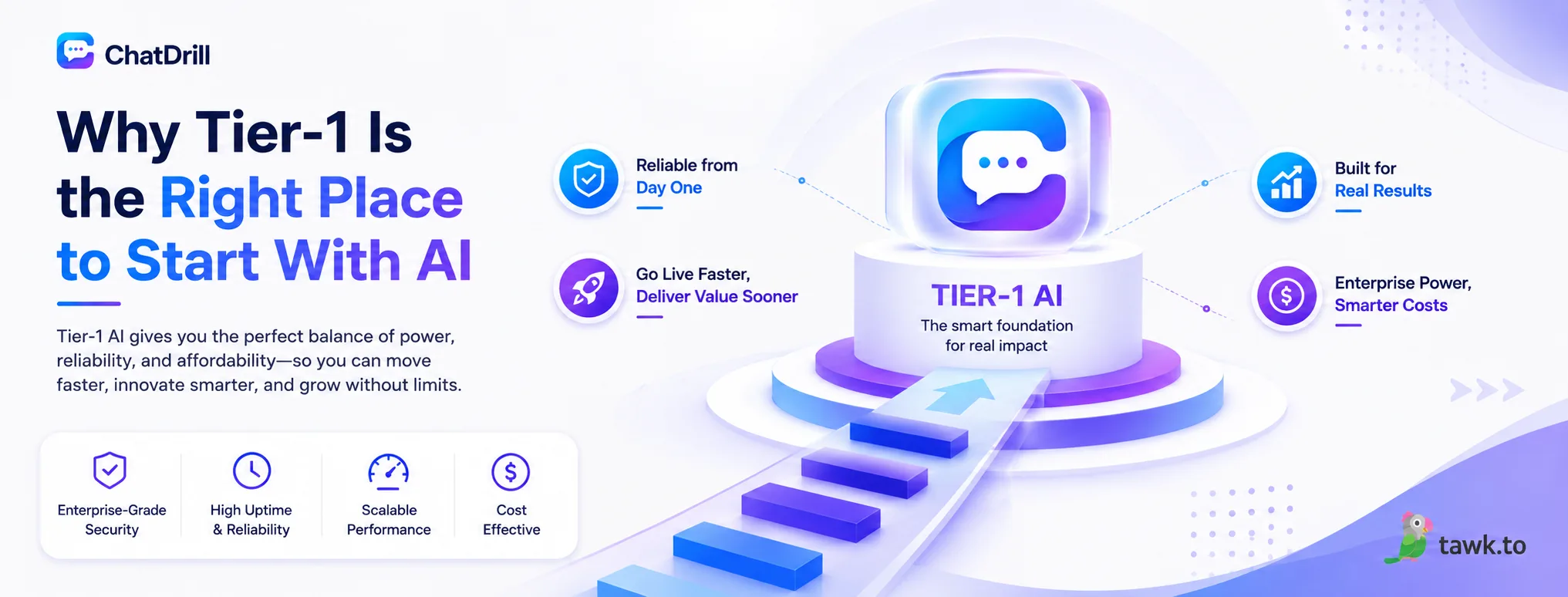
Tier-1's repetitive, predictable nature makes it genuinely well suited to AI automation, offering the clearest, lowest-risk path to meaningful efficiency gains before extending automation to more complex support tiers.
Predictability reduces AI risk
Because tier-1 questions have consistent, well-defined answers, AI is less likely to encounter genuinely ambiguous situations where hallucination or incorrect judgment becomes a real risk.
This lower risk profile makes tier-1 the natural starting point, letting a business build confidence in AI automation before considering more complex, higher-stakes support categories.
High volume means high potential impact
Tier-1 questions typically represent the largest share of total support volume, meaning even moderate AI automation success here delivers meaningfully large efficiency gains for the overall operation.
This volume-to-impact ratio is what makes tier-1 automation such a compelling starting investment, the effort-to-value ratio tends to be considerably more favorable here than starting with rarer, more complex issues.
Building organizational confidence
Successfully automating tier-1 gives a business and its team direct, tangible evidence that AI automation genuinely works well, building confidence and buy-in before considering broader automation efforts.
This confidence-building matters practically, teams and leadership more readily support expanding automation scope once they've seen it succeed clearly in this lower-risk starting category.
What AI Agents Can Realistically Handle at Tier-1
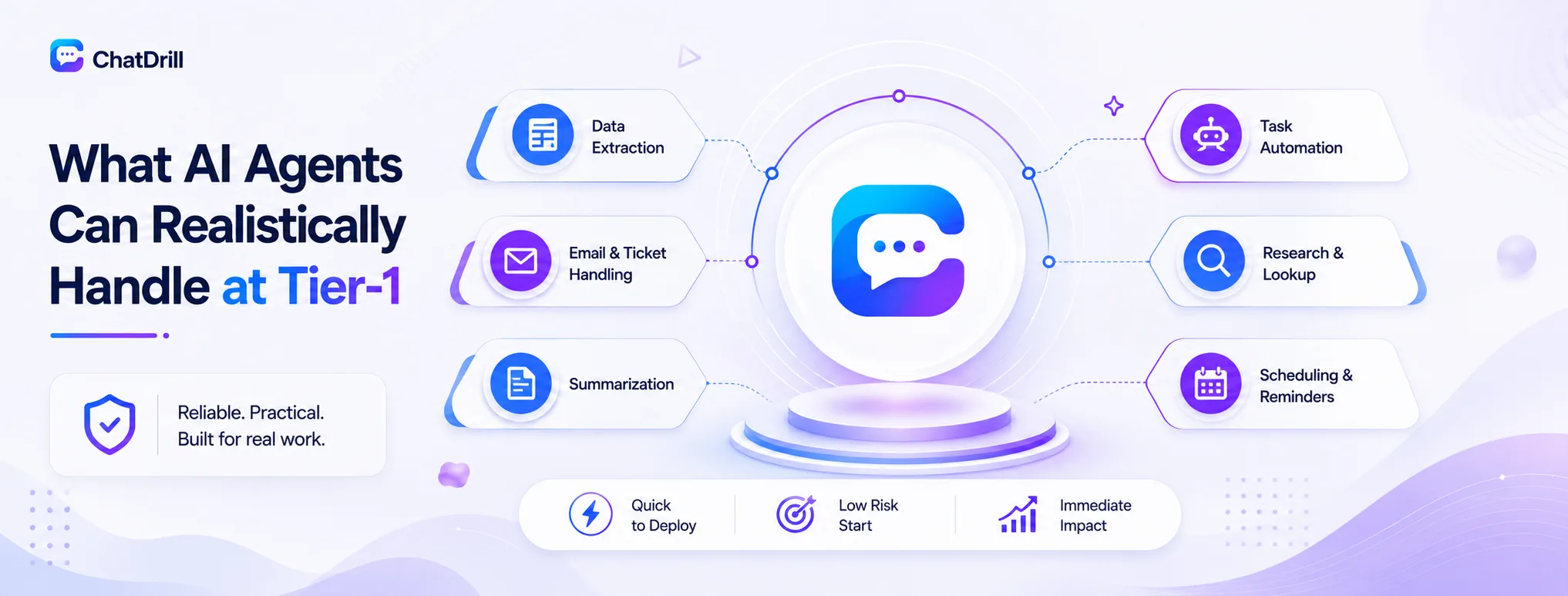
AI agents can reliably handle order status lookups, basic account information requests, common how-to questions, and straightforward policy questions, provided they're trained on accurate, current business-specific content.
Order and account status lookups
With proper system integration, AI can retrieve and communicate specific order or account status directly, one of the most common and reliably automatable tier-1 categories.
This category tends to show particularly strong deflection rates, since the underlying task, looking up and reporting a specific status, is well-suited to reliable automation.
Common how-to and product questions
Questions about how to use a specific feature or complete a common task can be reliably answered by AI trained on relevant documentation, provided that documentation is genuinely comprehensive and current.
This category benefits directly from the knowledge base training quality discussed in a related guide, since answer accuracy here depends heavily on underlying content completeness.
Straightforward policy questions
Standard, consistently applied policies, return windows, shipping timelines, basic billing questions, are well suited to AI handling given their consistent, non-negotiable nature.
This is distinct from policy exceptions or edge cases, which should typically remain a human-handled escalation category given their genuinely more judgment-dependent nature.
Step-by-Step: Automating Your Tier-1 Queue
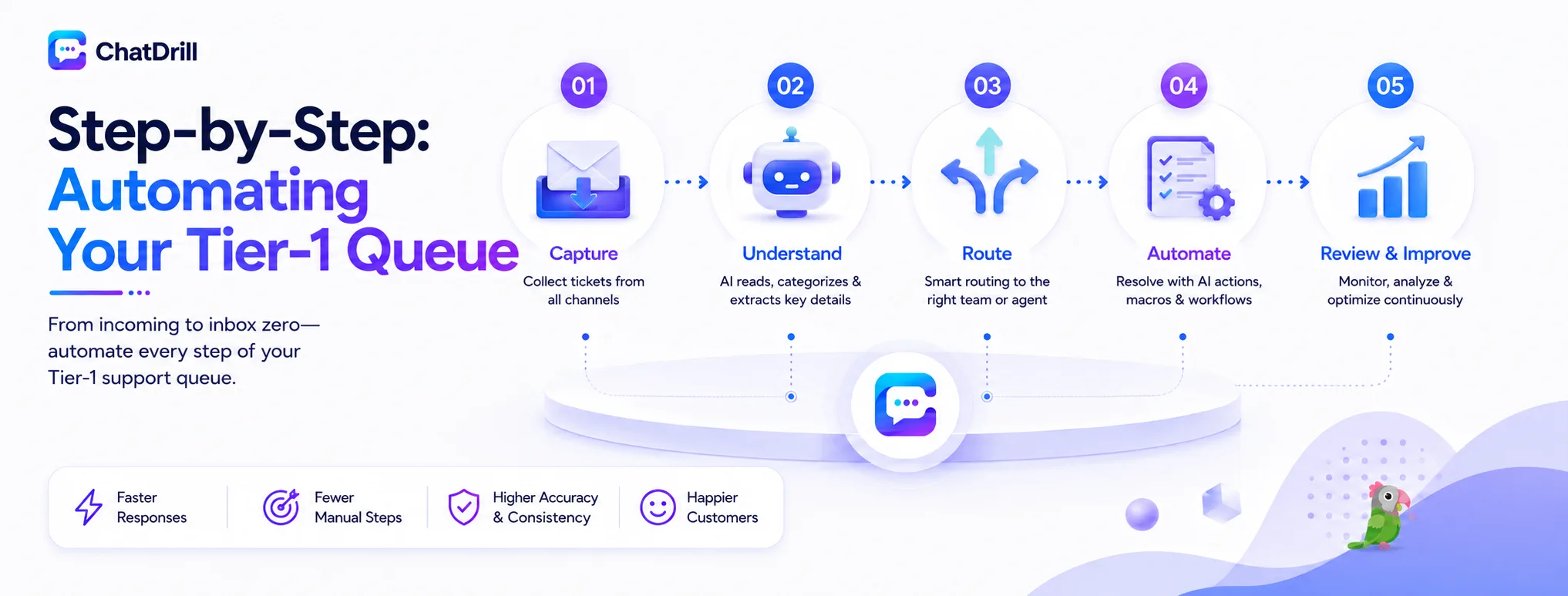
Automating tier-1 involves auditing your current tier-1 volume to identify the most common question types, training AI specifically on those categories, defining clear escalation boundaries for anything beyond tier-1 scope, and rolling out gradually while monitoring performance.
Step 1: Audit current tier-1 volume
Review recent support conversations to identify which specific question types genuinely make up your tier-1 volume, rather than assuming a generic category list applies exactly to your business.
This audit grounds the automation effort in real data, ensuring training investment focuses on the categories that will deliver the most actual impact.
Step 2: Train AI on identified categories
Focus initial training specifically on the question categories the audit revealed as most common, rather than attempting to cover every possible topic broadly and thinly from the start.
This focused approach tends to produce stronger initial results than a broader, shallower training effort, giving the AI genuine depth on the questions that matter most.
Step 3: Define clear escalation boundaries
Explicitly configure the AI to escalate anything outside the defined tier-1 scope, rather than attempting to handle genuinely more complex issues it wasn't specifically trained or designed for.
This boundary-setting keeps automation scope deliberately controlled, avoiding the risk of AI attempting resolution on issues genuinely requiring human judgment.
Step 4: Roll out gradually and monitor
Starting with a subset of tier-1 volume, or a limited time window, before full rollout lets a business catch and address any issues while the exposure is still manageable.
This gradual approach, paired with close monitoring during the initial period, builds confidence and catches configuration gaps before they affect the full volume of tier-1 conversations.
Measuring Tier-1 Automation Success
Measuring success means tracking deflection rate specifically for tier-1 categories, monitoring customer satisfaction on AI-handled conversations, and reviewing how much human agent capacity has genuinely freed up for tier-2 and tier-3 work.
Tier-1-specific deflection rate
Tracking deflection rate specifically within the defined tier-1 category, rather than as one blended number across all support volume, gives the clearest signal of automation success in this specific area.
This focused metric also helps identify which specific tier-1 subcategories are performing well versus which need additional training investment.
Satisfaction on AI-handled conversations
Monitoring CSAT specifically for AI-resolved tier-1 conversations confirms whether high deflection is genuinely reflecting good resolution, not just conversations being closed without real satisfaction.
This paired tracking, deflection alongside satisfaction, prevents over-optimizing purely for automation volume at the expense of actual customer experience quality.
Freed human agent capacity
Tracking how much time human agents now spend on tier-2 and tier-3 work, versus tier-1 volume, quantifies the actual capacity benefit automation has delivered for the broader support operation.
This capacity data is often the most compelling evidence for justifying continued or expanded AI investment to stakeholders evaluating the program's overall business value.
How ChatDrill Supports Tier-1 Automation
ChatDrill's AI can be trained specifically on common tier-1 question categories, supports clear escalation configuration for anything beyond that scope, and provides reporting on deflection rate and satisfaction to track automation success over time.
Focused training capability
ChatDrill lets a business train its AI specifically on identified tier-1 categories, giving the automation effort genuine depth on the questions that matter most for a specific support operation.
This targeted training approach directly supports the audit-then-train methodology covered earlier, letting real conversation data drive where training investment focuses.
Built-in reporting for tracking success
ChatDrill's analytics dashboard tracks deflection rate and satisfaction automatically, giving a business the data needed to measure tier-1 automation success without building separate manual tracking.
This built-in visibility supports the ongoing monitoring and refinement that keeps tier-1 automation genuinely improving over time, rather than plateauing after initial setup.
Frequently Asked Questions
What is tier-1 support exactly?
Tier-1 support covers routine, well-defined customer questions, order status, basic account information, common how-to questions, that don't require specialized troubleshooting or judgment to resolve accurately.
Why should businesses start AI automation with tier-1 support?
Tier-1's predictable, repetitive nature makes it lower-risk for AI automation, while its typically high volume means even moderate automation success delivers meaningful efficiency gains for the overall support operation.
Does ChatDrill support tier-1 automation specifically?
Yes, ChatDrill's AI can be trained specifically on identified tier-1 categories, with configurable escalation boundaries for anything beyond that scope, and built-in reporting to track automation success.
How do I know what counts as tier-1 for my specific business?
Auditing your recent support conversations to identify the most common, well-defined question types grounds this definition in real data rather than assuming a generic industry category list applies exactly.
What metrics should I track for tier-1 automation success?
Deflection rate specific to tier-1 categories, customer satisfaction on AI-handled conversations, and freed human agent capacity for tier-2 and tier-3 work together give a comprehensive view of automation success.
Can tier-1 automation eventually expand to more complex issues?
Yes, many businesses gradually expand AI scope to tier-2 issues as confidence and AI capability grow, though this expansion should be deliberate and monitored rather than assumed to happen automatically.