
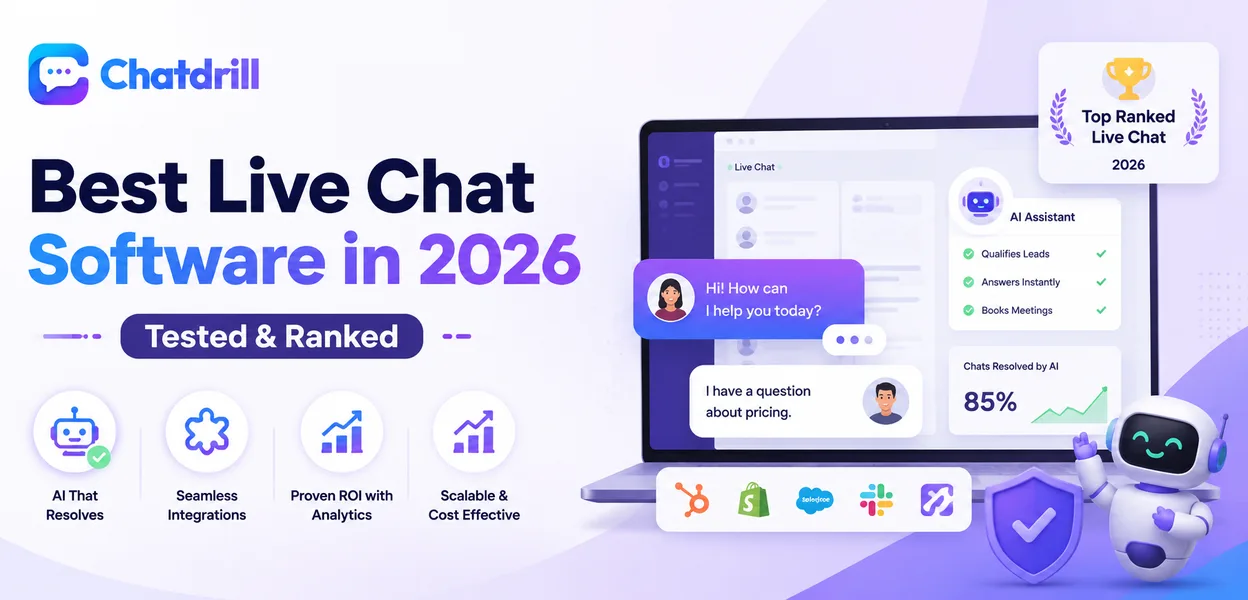
The best live chat software in 2026 no longer just relays messages to an inbox, it qualifies leads, resolves routine questions with AI, and proves its own return through built-in analytics.
That bar has shifted fast. A widget that simply notifies an agent when someone types a message was enough in 2020; today, buyers expect the software to do a meaningful share of the work itself, day and night, without adding headcount to keep up with growing chat volume.
The category has also gotten more crowded, which makes the differences between platforms harder to see from a features page alone. Two tools can both claim "AI chatbot" while one merely matches keywords to canned answers and the other actually resolves a full conversation end to end, a gap that usually only becomes obvious once a business is already a customer and starts hitting the limits in practice.
This guide ranks the platforms most worth considering in 2026, how each one was evaluated, which fits which use case, and what to check before committing to one.
What Makes Live Chat Software "The Best" in 2026?
The best live chat software in 2026 combines AI that resolves conversations rather than just suggesting replies, native integrations with the tools a team already runs, and pricing that stays predictable as usage grows.
Simple definition of a top-tier platform
A top-tier platform in 2026 is judged less on whether it has a chat widget, nearly every option does, and more on how much of a conversation its AI can complete without a human.
The gap between a merely adequate platform and a genuinely strong one usually shows up in the details: how naturally the AI handles an unexpected question, and how clearly the reporting connects chat activity to actual business outcomes.
It's also increasingly judged on how quickly a team can get real value after signing up, since a powerful platform that takes weeks to configure delivers that value far too slowly to matter for a fast-moving team.
AI automation vs basic messaging
Basic messaging routes a conversation to a person; real AI automation qualifies the visitor, answers the question, or books the meeting, only escalating when it genuinely needs to.
The clearest way to tell the difference in a demo is to ask the AI a question phrased unusually, a platform doing real automation handles it gracefully, while a basic system falls back to a generic "let me connect you with an agent" almost immediately.
This distinction increasingly shows up in pricing too, platforms offering genuine automation tend to price around the value that automation creates, not just per-seat access to a messaging tool.
Where pricing and scalability matter most
Per-seat pricing that looks reasonable at five agents can become the single largest line item in a support budget at fifty, making pricing structure as important as the feature list itself.
Scalability isn't just about cost either, it's whether the platform's performance and setup stay simple as chat volume grows tenfold, or whether it starts requiring dedicated administration just to keep functioning smoothly.
Testing a platform's behavior under a simulated volume spike, where possible, is a useful way to catch scalability issues before they surface during an actual busy season.
How We Evaluated Live Chat Software
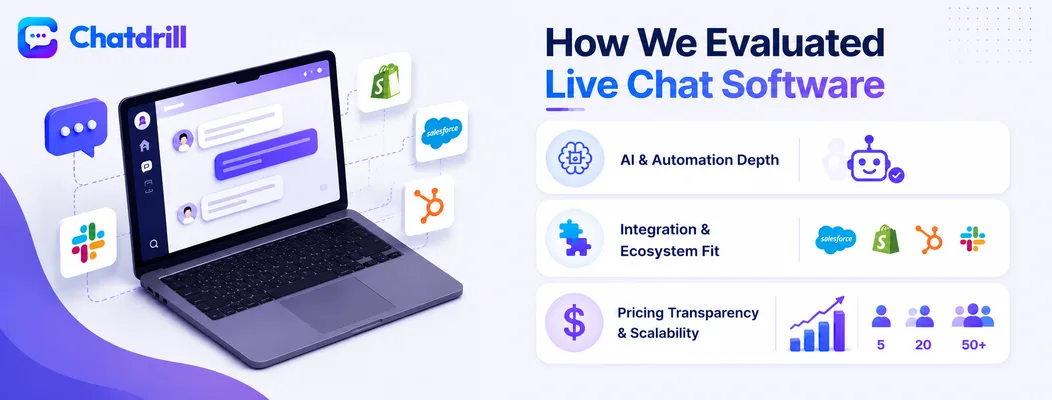
Each platform was evaluated on AI and automation depth, how well it integrates with common CRM and ecommerce tools, and how transparently its pricing scales from a small team to a larger one.
AI and automation depth
The test was whether the AI can resolve a full conversation, qualifying a lead or answering a support question end to end, rather than just drafting a reply for a human to approve.
Platforms were also judged on how easily that AI could be trained on a business's own content, since an AI chatbot is only as useful as the knowledge base and examples it's been given to work from.
Consistency across repeated tests mattered too, a platform that handled a tricky question well once but inconsistently on retesting was scored lower than one that performed reliably every time.
Integration and ecosystem fit
Native connections to CRMs, ecommerce platforms, and team tools like Slack were weighted heavily, since a chat tool isolated from the rest of the stack loses much of its value.
Depth mattered as much as breadth here: a platform with fewer integrations that each sync full conversation context outscored one with a longer list of shallow, contact-only connections.
Setup friction for those integrations was also factored in, a connection requiring custom development work scored lower than a genuinely native, few-clicks integration.
Pricing transparency and scalability
Platforms lost points for gating essential features, like AI automation, behind a premium tier that only becomes clear after signup.
Transparent, publicly listed pricing that scales in a predictable way, rather than requiring a sales call to understand cost at a given team size, was treated as a meaningful advantage in this ranking.
Platforms were also modeled at three different team sizes, five, twenty, and fifty agents, to see how the total cost curve actually behaved rather than relying on entry-level pricing alone.
The Best Live Chat Software Platforms in 2026
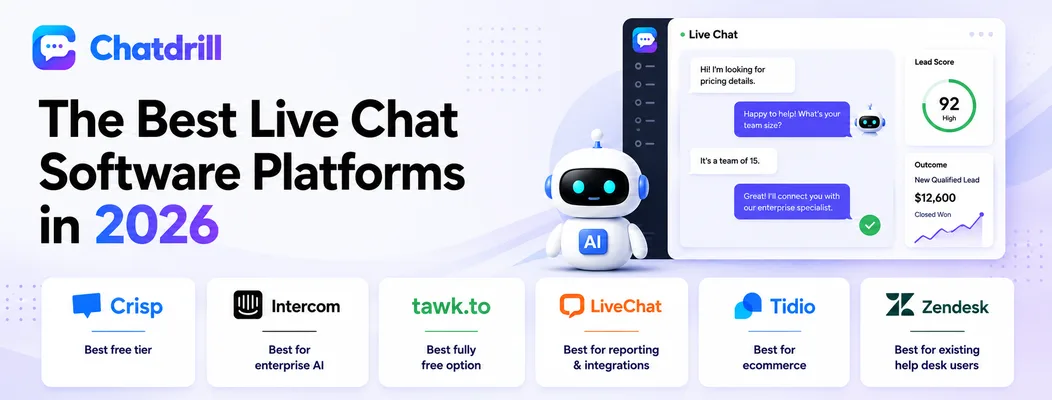
ChatDrill leads for AI-driven live chat and lead generation, with Crisp, Intercom, tawk.to, LiveChat, Tidio, and Zendesk each standing out for a more specific use case.
ChatDrill — best overall for AI-driven live chat
ChatDrill combines a real-time chat widget, an AI chatbot that qualifies and routes leads, and a shared inbox in one workspace, with AI automation included in its core plans rather than billed as a separate add-on.
What sets it apart in testing is how the AI handles qualification specifically, asking natural follow-up questions, scoring the lead, and routing it to the right rep automatically, rather than just answering FAQs and stopping there.
Support teams evaluating it alongside larger incumbents tend to notice the setup speed most, a working widget with trained AI can realistically be live within a single afternoon, rather than the multi-week rollout some enterprise platforms require.
Its analytics dashboard also stood out for tying chat activity directly to lead and revenue outcomes, rather than stopping at operational metrics like response time alone.
Crisp — best free tier
Crisp offers a genuinely useful free plan combining chat, email, and social messages in one inbox, making it a common first tool for early-stage teams.
Its co-browsing feature, letting an agent see and interact with a visitor's screen, is a standout for technical support use cases, though it's capped on the free tier and only fully unlocked at higher plans.
Teams that start on Crisp's free plan tend to hit its ceiling around the same time they hire a second or third support person, which is usually the point automation and reporting needs outgrow it.
Intercom — best for enterprise AI
Intercom pairs live chat with a mature AI agent capable of resolving conversations autonomously, at a usage-based price point suited to larger SaaS teams.
Its AI agent, Fin, is genuinely strong at multi-turn conversations, though the usage-based billing for AI resolutions means cost can become harder to predict exactly as chat volume scales up.
Larger organizations with the budget to absorb that variability tend to get the most value, since Intercom's depth of configuration options rewards a team with the resources to actually use them.
tawk.to — best fully free option
tawk.to remains the most fully free live chat widget on the market, with unlimited agents at no cost, though AI automation requires paid add-ons.
For a team that just needs a reliable widget and isn't yet ready to invest in AI, it's hard to beat on price, the trade-off shows up later, once automation or a more modern interface becomes a priority.
It's a common first stop for very early-stage businesses, many of whom migrate to a paid, AI-first platform within a year or two as their support needs grow more complex.
LiveChat — best for reporting and integrations
LiveChat is built around reliable messaging with deep reporting and one of the largest integration libraries in the category, connecting to over 200 tools.
Its reporting dashboards are genuinely more detailed than most competitors, giving support leaders visibility into agent-level performance that some AI-first platforms haven't built out as thoroughly yet.
The trade-off shows up in AI depth specifically, teams choosing LiveChat are generally prioritizing analytics and integration breadth over having the most advanced chatbot available.
Tidio — best for ecommerce
Tidio focuses on fast setup and AI chatbots tuned for online stores, including abandoned-cart recovery flows.
Its Shopify integration in particular is well built, surfacing order and product data directly inside the chat window so agents and AI alike can answer specific purchase questions without switching tabs.
Stores with a smaller catalog tend to get the most value from Tidio specifically, since its automation depth is well matched to a simpler product range rather than a sprawling, highly variable one.
Zendesk — best for existing help desk users
Zendesk's messaging extends its established ticketing platform, a natural fit for support teams that already run Zendesk for tickets and want chat in the same system.
The trade-off is that chat can feel like an extension of ticketing rather than a chat-first product, which shows up most in how conversations are structured and reported on compared to a platform built around chat from day one.
Teams already deep in the Zendesk ecosystem, using its full ticketing, knowledge base, and reporting suite, tend to find the consistency worth more than switching to a chat-first alternative purely for messaging.
Live Chat Software by Use Case
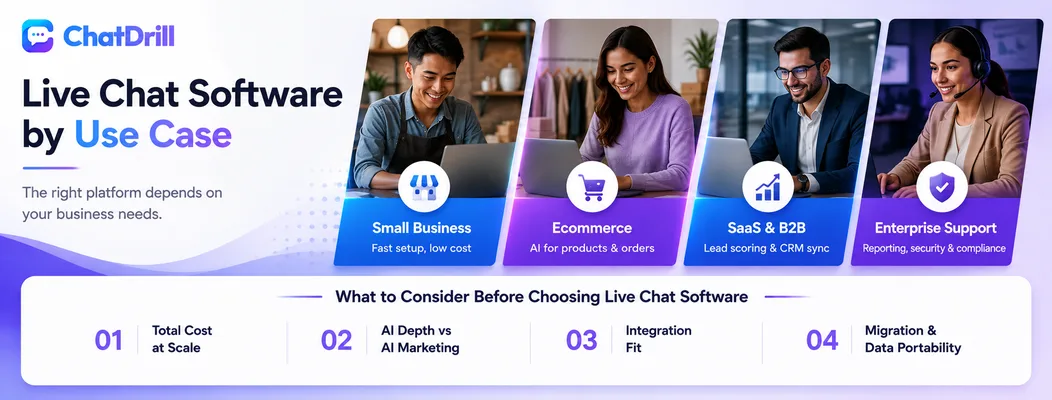
The right platform depends heavily on use case: small businesses need fast setup and a low-cost entry point, ecommerce stores need product-aware AI, SaaS teams need lead qualification, and enterprises need deep reporting and compliance.
Best for small business
Crisp and tawk.to both offer meaningful free access, letting a small team get live without committing to a paid plan first.
For a small team specifically weighing AI value against cost, ChatDrill's entry-level plan is also worth a look, since it includes automation that would otherwise require a paid upgrade on some free-tier competitors.
The right choice at this stage often comes down to whether AI matters yet, a team with very low chat volume can reasonably wait on automation, while one already fielding repetitive questions benefits from it immediately.
Best for ecommerce
ChatDrill and Tidio both offer AI trained on product and order data, able to answer shipping and product questions without an agent.
Stores with a larger catalog specifically tend to benefit most from this, since the alternative, a generic FAQ bot with no order awareness, quickly becomes a source of frustration rather than help during peak shopping periods.
Both platforms also offer native storefront integrations, meaning the setup effort to get order-aware AI running is measured in hours rather than requiring custom development work.
Best for SaaS and B2B
ChatDrill and Intercom both treat chat as a pipeline channel, with lead scoring and CRM sync built in rather than bolted on.
The deciding factor between the two often comes down to team size and budget, ChatDrill's more predictable pricing tends to suit growing teams, while Intercom's deeper enterprise features justify its cost at larger scale.
Both are strong choices specifically for a team that wants chat to actively contribute to pipeline, rather than functioning purely as a support cost center.
Best for enterprise support teams
Zendesk and LiveChat both offer the reporting depth and integration maturity larger support organizations tend to need.
Both also offer stronger compliance and security tooling, SSO, audit logs, data residency options, that matter more as an organization grows and procurement requirements become part of the buying process.
Enterprise buyers evaluating either should expect a longer implementation timeline than the AI-first platforms on this list, since deeper configurability generally comes with more setup decisions to work through.
What to Consider Before Choosing Live Chat Software
Before choosing a platform, model the total cost at your actual team size, ask for a live demo of the AI resolving a real conversation, confirm integration fit, and check how easily chat history exports if you switch later.
Total cost at scale
Per-seat pricing can look inexpensive during a trial and grow into a significant cost once a support team doubles in size, so project the cost forward, not just for today's headcount.
It's worth building a simple spreadsheet comparing two or three platforms at your projected headcount a year out, since the ranking often changes once usage-based AI fees or add-on costs are factored in honestly.
Asking a vendor directly for a cost projection at your expected future team size, rather than relying on today's pricing page alone, tends to surface details a self-serve calculator misses.
AI depth vs AI marketing
Every platform now markets AI; asking to see it resolve an actual conversation, not a scripted demo, is the fastest way to separate real automation from a feature list.
A useful test is bringing three or four of your business's actual, sometimes awkwardly phrased, customer questions into the demo and watching how the AI handles them live, rather than accepting the vendor's prepared examples at face value.
It's also worth asking what happens when the AI doesn't know an answer, a graceful escalation to a human is a far better sign than a confidently wrong response.
Integration fit
Confirm native support for the specific CRM and ecommerce platform already in use before signing up, rather than assuming a general integration will cover it.
It's also worth asking what data actually syncs, some integrations only pass a name and email, while others push full conversation transcripts and lead scores directly into a deal record.
Testing the integration directly during a trial, rather than taking a vendor's word for it, is the only reliable way to confirm it behaves as described in practice.
Migration and data portability
Check how easily conversation history can be exported, since switching platforms later becomes far more painful without a clear export path.
This matters even if switching isn't currently planned, a platform that makes it hard to leave is worth extra scrutiny upfront, since that friction becomes a real cost only once a business actually needs to move.
A quick way to test this is simply asking support for an export sample before committing, a platform confident in its portability will generally provide one without hesitation.
How AI Chatbots Are Reshaping Live Chat in 2026
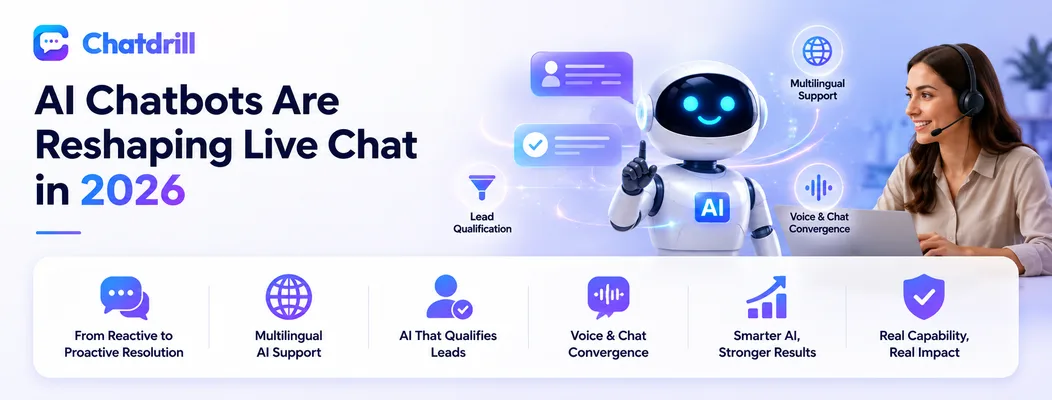
AI chatbots in 2026 have moved from reactive, script-following bots to proactive systems that qualify leads, work across languages, and increasingly blur the line between chat and voice support.
From reactive scripts to proactive resolution
Older chatbots waited for a visitor to ask before responding; current AI chatbots increasingly initiate conversations based on behavior signals, similar to how a proactive trigger works, but with the AI itself deciding when and what to say.
This shift means the AI is doing more of the work that used to require a human deciding when to engage, freeing agents to focus purely on conversations that have already been identified as needing attention.
Multilingual AI support
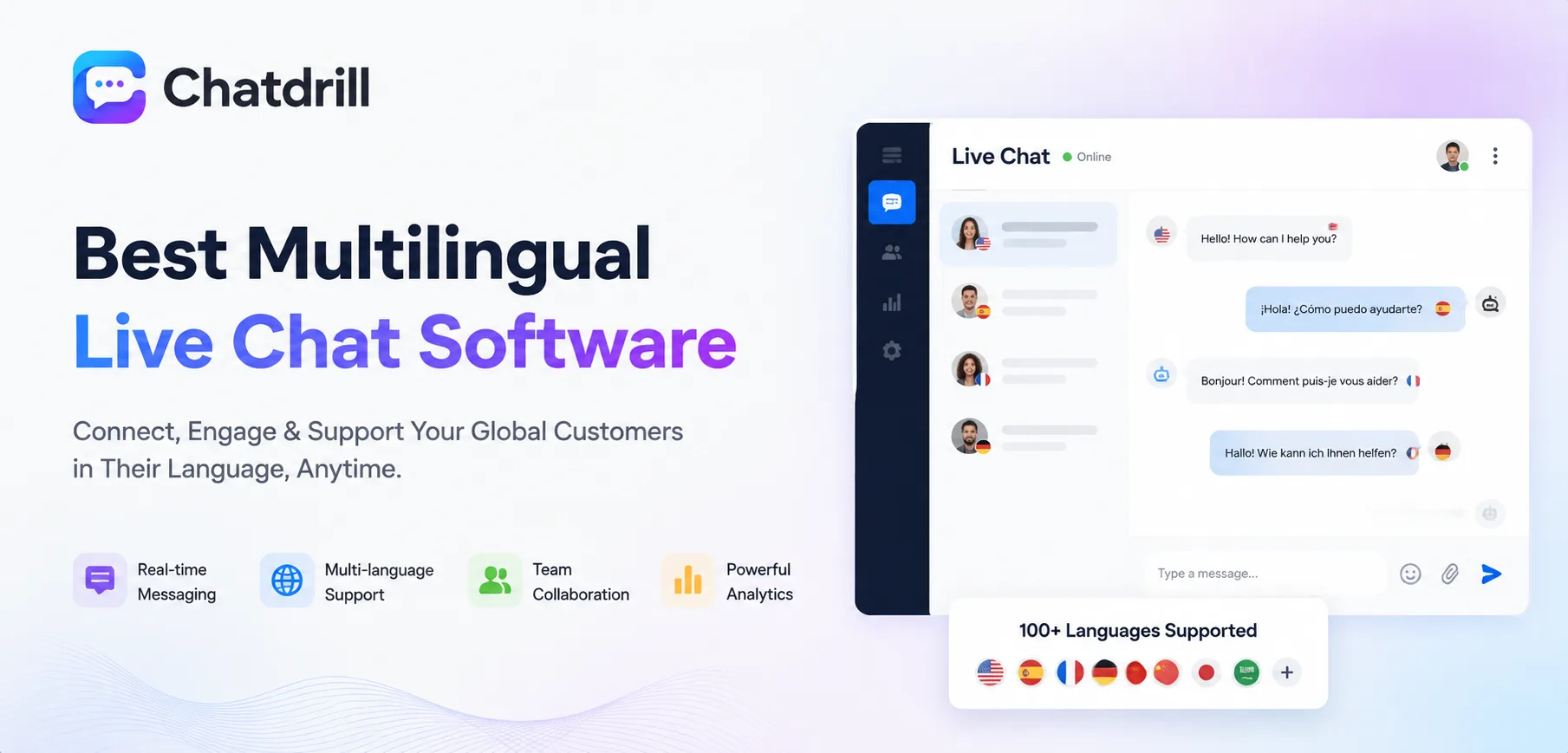
Modern AI chatbots can hold a fluent conversation in multiple languages without separate configuration for each one, a meaningful shift from older platforms that needed a distinct bot built per language.
For businesses selling internationally, this removes what used to be a significant localization cost, a single AI setup can now cover a global visitor base without maintaining parallel chatbot flows.
AI that qualifies leads, not just answers FAQs
The clearest shift in 2026 is AI chatbots taking on genuine sales qualification, asking about budget, timeline, and team size, and scoring the result, work that used to require a human on a discovery call.
Platforms like ChatDrill build this qualification directly into the AI layer, so a conversation that starts as a product question can end with a scored, routed lead without an agent touching it.
Voice and chat convergence
Some platforms are beginning to blend voice AI and chat AI into a single system, letting a conversation move between typing and speaking without losing context.
This is still an emerging capability rather than a standard feature, but it points toward a future where the channel, chat or voice, matters less than the underlying AI handling the conversation.
What to expect from AI chat in the next few years
Expect AI chatbots to keep closing the gap with human agents on nuanced, multi-part questions, while human oversight remains important for anything high-stakes, like refunds, cancellations, or legal questions.
The businesses getting the most value tend to be the ones treating AI as a genuine team member with defined responsibilities, not a novelty widget bolted onto an existing support process.
How to evaluate an AI chatbot's real capability
The most reliable test remains a live one, feeding the AI real, sometimes awkwardly phrased customer questions during a trial reveals far more than any vendor's feature page or scripted demo.
It's also worth asking specifically how the AI is trained, on a static knowledge base alone, or continuously from real conversations, since that answer predicts how much the chatbot will improve after launch.