

The speed of SaaS onboarding directly affects whether a genuinely interested new user reaches real value quickly enough to stay engaged, or gets stuck on a confusing step long enough to quietly disengage before ever experiencing the product's actual worth.
Quick answer: Live chat speeds up SaaS onboarding by resolving setup confusion the moment it happens, rather than letting a stuck new user wait for a delayed email reply or give up entirely, directly shortening the time it takes a genuinely new user to reach their first meaningful moment of value.
Live chat's real-time nature makes it uniquely suited to this specific challenge, since the moment a new user gets confused is exactly the moment their motivation to push through that confusion is highest, and a delayed response wastes that narrow window.
Understanding which specific onboarding moments benefit most from chat, and the tactics that maximize its speed advantage, helps a SaaS business meaningfully compress the time it takes new users to genuinely succeed.
This guide covers the speed mechanism, specific tactics for faster onboarding, common mistakes, measuring the actual impact, and how ChatDrill supports faster SaaS onboarding.
The Mechanism Behind Faster Onboarding
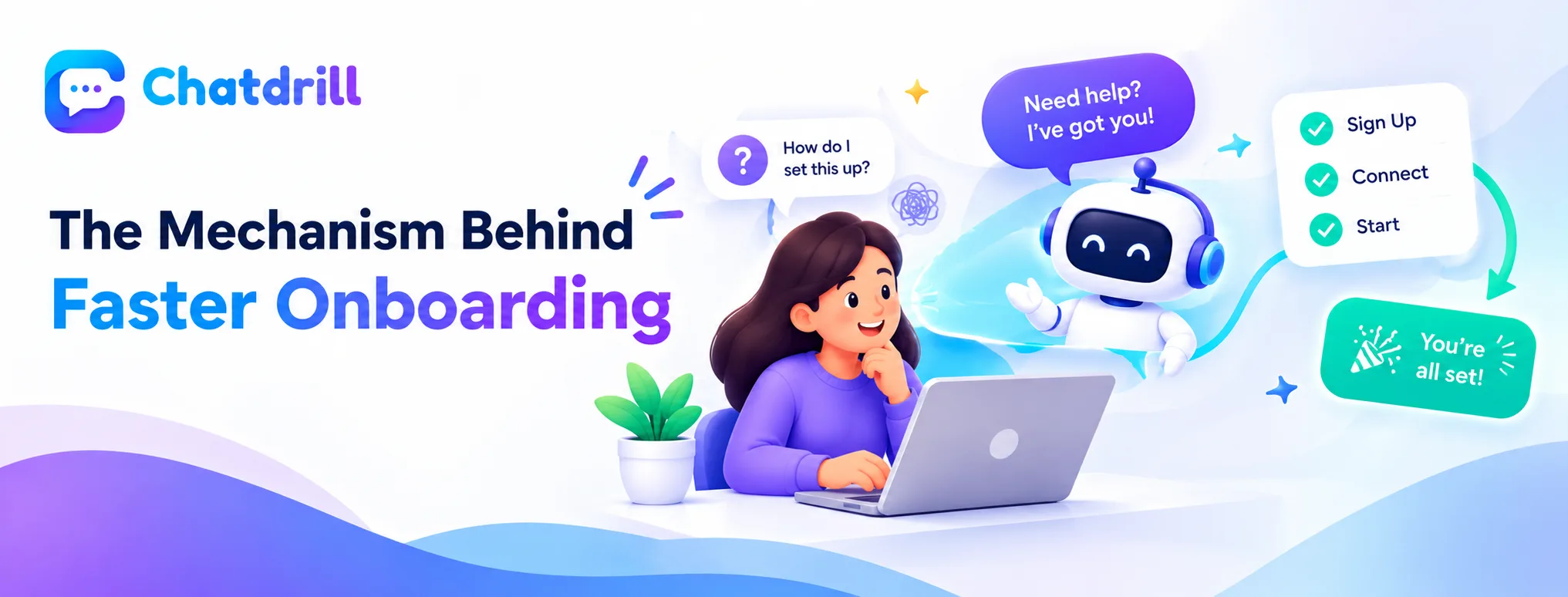
Chat speeds up onboarding by resolving confusion at the exact moment motivation is highest, rather than letting momentum fade during a delayed wait for help.
Capturing motivation at its peak
A new user hitting a confusing setup step is generally at their most motivated to resolve it immediately, since they've just invested effort getting that far, and chat's real-time response captures this peak-motivation moment rather than losing it to a delayed reply.
This timing advantage compounds directly into onboarding speed, since every hour a confused user waits for help is an hour their motivation and attention can drift toward other priorities instead.
AI-assisted chat specifically extends this capture capability around the clock, addressing confusion that happens outside typical support hours just as effectively as during them.
Preventing the quiet, undetected abandonment
A new user who gets stuck without any easy way to get immediate help often abandons quietly, without ever explicitly signaling their frustration through a support ticket, meaning this specific abandonment often goes entirely undetected without a system like chat to intervene.
Chat's presence throughout the onboarding flow specifically addresses this silent abandonment risk, giving a stuck user an immediate, low-effort path to resolution before they give up.
Specific Tactics for Faster SaaS Onboarding
Placing chat prominently within the actual onboarding flow and training AI on your most common setup confusion points both meaningfully accelerate time-to-value.
Placing chat within the onboarding flow itself
Ensuring chat is prominently visible during the actual onboarding steps, not just generally available somewhere on the site, ensures a confused new user encounters help exactly where and when they need it most.
This in-flow placement produces considerably better results than a chat widget that exists but isn't specifically surfaced during the onboarding experience itself.
Training AI on your most common confusion points
Reviewing your own onboarding data to identify the specific steps where new users most commonly get stuck, then training your chat AI specifically on resolving exactly these points, directly targets your largest source of onboarding friction.
This data-driven prioritization ensures your training investment addresses your genuinely highest-impact confusion points first, rather than spreading effort evenly regardless of actual friction data.
Common Mistakes That Slow Onboarding
Making chat available but not proactively offering it during a struggle, and providing generic rather than step-specific guidance, both limit chat's speed benefit.
Not proactively offering help during a visible struggle
Waiting for a new user to actively seek out chat, rather than proactively offering help when their behavior suggests genuine struggle, a long pause, repeated attempts at the same step, misses the opportunity to intervene before frustration fully sets in.
Configuring proactive chat triggers based on these genuine struggle signals captures a meaningful share of users who wouldn't have actively sought help despite genuinely needing it.
Providing generic rather than step-specific guidance
A generic "how can I help?" response, without the AI or agent knowing exactly which onboarding step the user is currently stuck on, requires additional back-and-forth to establish context that a step-aware system could skip entirely.
Configuring chat to have visibility into the user's current onboarding step, where technically feasible, lets the response address the genuine, specific confusion immediately rather than starting from a generic baseline.
Measuring the Actual Onboarding Speed Impact
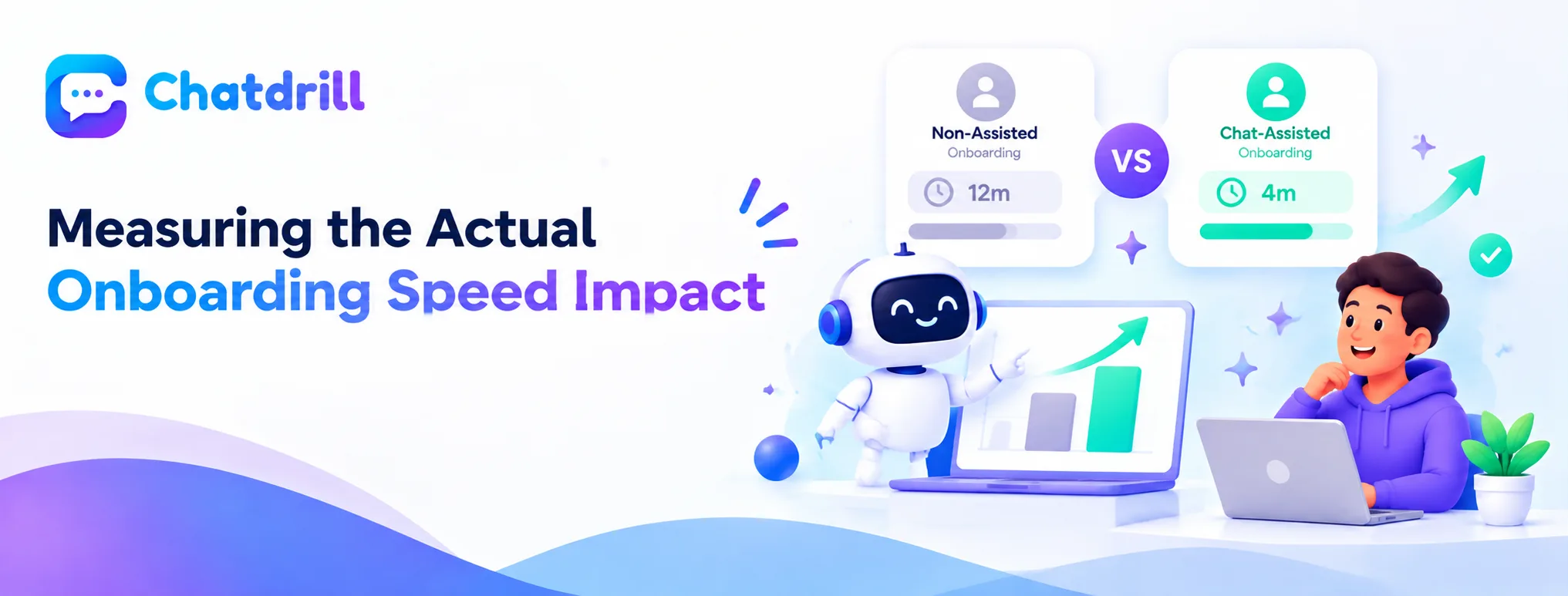
Comparing time-to-first-value between chat-assisted and non-assisted onboarding cohorts reveals chat's genuine contribution to onboarding speed.
Tracking time-to-first-value by cohort
Measuring how long it takes new users to reach a defined "first value" milestone, separately for those who engaged with chat during onboarding versus those who didn't, provides a direct, genuine comparison of chat's actual speed contribution.
This comparison should account for the possibility that users who proactively seek chat help might already be more engaged or motivated than average, a measurement nuance worth keeping in mind.
Identifying which specific steps chat improves most
Reviewing which specific onboarding steps show the largest time-to-value improvement when chat is involved reveals where chat delivers its most concentrated value, informing where to prioritize further training or in-flow placement investment.
This step-level view produces more actionable insight than a single, blended overall onboarding-speed metric alone.