
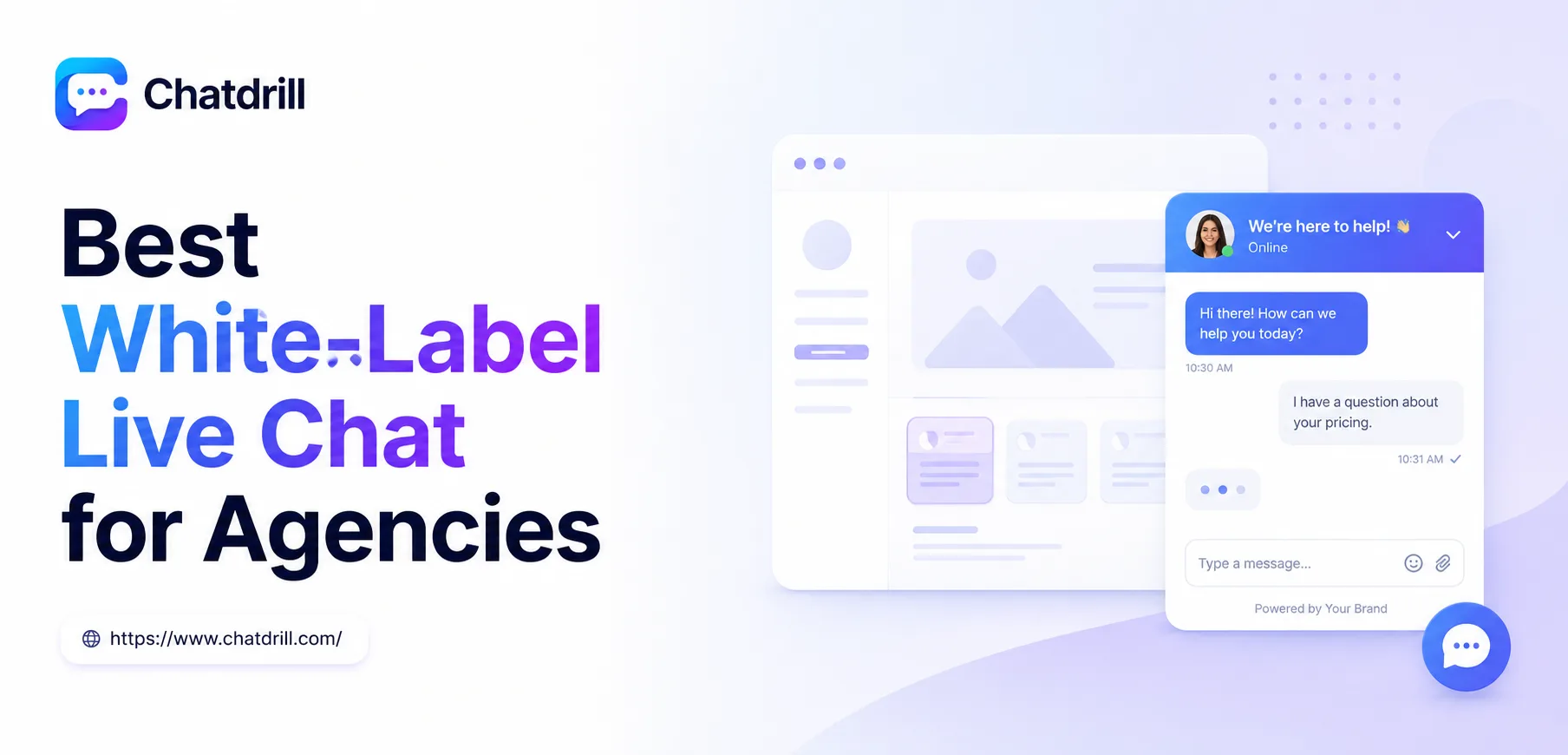
White-label live chat lets an agency deploy chat under its own brand across every client site it manages, removing the underlying platform's name and branding entirely so the tool looks like a genuine part of the agency's own service offering.
This matters specifically for agencies managing support, marketing, or web services for multiple clients, where reselling a visibly third-party tool undercuts the agency's own brand positioning and makes it harder to present chat as a value-added service worth paying for.
Not every live chat platform offers genuine white-labeling, some only allow superficial color customization while still displaying the platform's own name somewhere in the widget, making it worth confirming exactly how complete the white-label capability actually is before committing.
Beyond branding, agencies specifically need to manage multiple client accounts efficiently from one place, making multi-client administration and billing flexibility just as important as the white-label capability itself.
This guide covers what agencies should look for in a white-label chat platform, the strongest options in 2026, how they fit different agency business models, a closer look at pricing structures for reselling, and what to plan for before adopting one across a client base.
Why Agencies Need White-Label Live Chat
Agencies need white-label live chat because reselling a visibly third-party tool undermines their own brand positioning with clients, while genuine white-labeling lets chat appear as a natural part of the agency's own service offering.
The branding problem with reselling a visible third-party tool
A client seeing an unfamiliar platform's name in the chat widget on their own site can create confusion about who actually built or manages the tool, undercutting the agency's positioning as the service provider.
This matters especially for agencies charging a premium for their managed services, where the perceived ownership of every tool involved factors into the value clients feel they're getting.
Why this matters more as an agency scales its client base
A single client might not notice or mind a third-party brand in their chat widget, but as an agency manages dozens of client sites, consistent white-labeling becomes central to a coherent, scalable service offering.
This consistency also simplifies the agency's own marketing and sales conversations, presenting chat as a proprietary-feeling capability rather than a visibly outsourced add-on.
What genuine white-labeling actually requires
True white-labeling removes every visible reference to the underlying platform, not just the widget's primary color, including any footer text, powered-by links, or default branding in automated messages.
Confirming this completeness directly, rather than assuming a platform's marketed white-label feature covers everything, avoids an awkward surprise once deployed to a client.
What to Look for in a White-Label Live Chat Platform
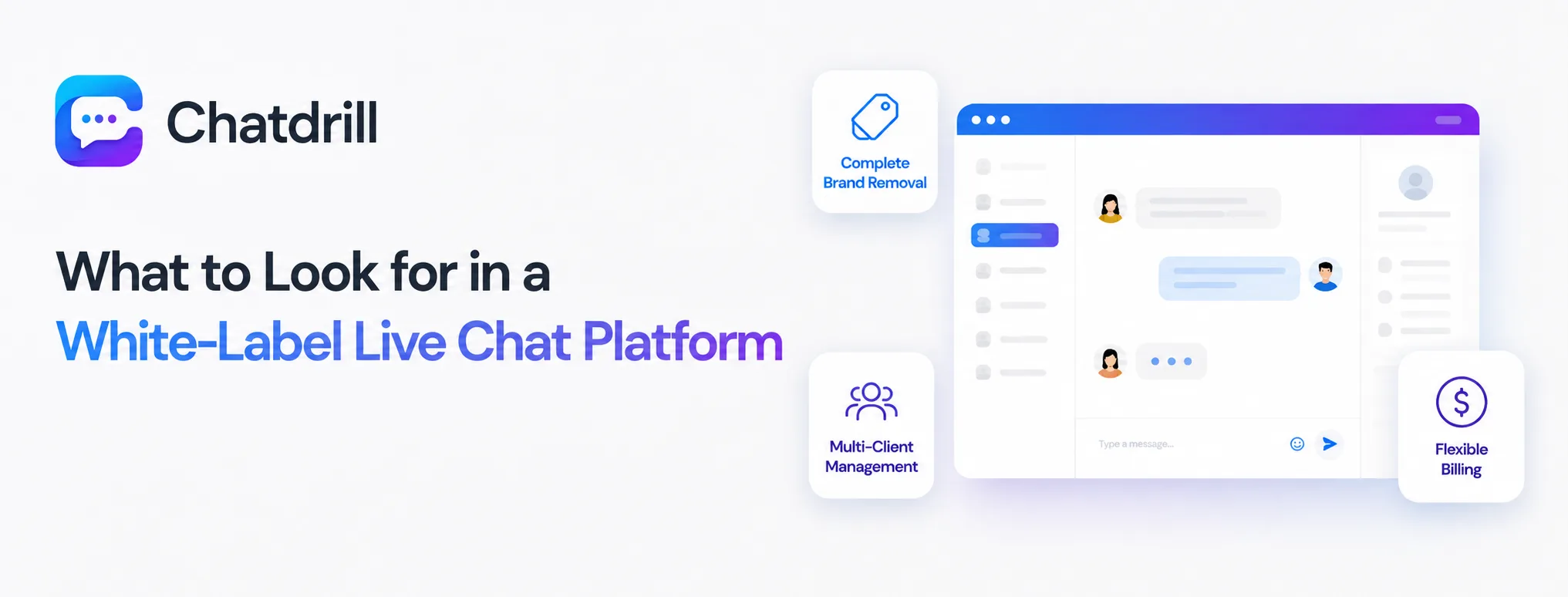
A strong white-label platform for agencies offers genuinely complete brand removal, efficient multi-client account management, and flexible billing that supports reselling at whatever margin the agency's business model requires.
Genuinely complete white-labeling
Verify every touchpoint, widget interface, automated emails, any client-facing dashboard, can be fully rebranded, not just the most visible surface elements.
Testing this thoroughly during a trial, checking every corner of the client-facing experience, confirms the white-labeling is genuinely complete rather than partial.
Efficient multi-client account management
An agency managing many client accounts needs a centralized way to administer, monitor, and support all of them without needing to log into each client's instance separately.
This administrative efficiency becomes increasingly important as an agency's client base grows, worth weighing heavily even if it's not the most visible feature during initial evaluation.
Flexible reseller billing
Look for pricing that supports an agency's own margin structure, whether that's a wholesale rate the agency marks up, or a revenue-share model, rather than a rigid structure that doesn't accommodate reselling.
Clarifying this billing structure directly with a platform before committing avoids discovering later that the pricing model doesn't actually support the agency's intended business approach.
The Best White-Label Live Chat Platforms for Agencies
ChatDrill leads for genuinely complete white-labeling with AI included, with Tidio, Crisp, Chatra, and Smartsupp each fitting a more specific agency use case or budget level.
ChatDrill — best overall for agencies wanting AI-inclusive white-label chat
ChatDrill offers genuinely complete white-labeling across the widget and client-facing touchpoints, with AI automation included rather than requiring a separate reseller add-on.
Its multi-client account management is built with agency use in mind, letting a team administer several client instances efficiently from one central place.
Agencies specifically wanting to resell AI-driven chat, not just basic messaging, tend to find this combination difficult to match elsewhere.
Tidio — best for agencies serving ecommerce clients
Tidio's white-label option, where available on its higher tiers, pairs with product-aware AI automation well suited to an agency's ecommerce client base specifically.
This specialization makes it a strong fit for an agency whose client roster leans heavily toward online stores rather than general businesses.
Agencies with a broader, non-ecommerce client base may find Tidio's specific strengths less universally applicable across their full roster.
Crisp — best lower-cost white-label starting point
Crisp offers white-labeling on its higher-tier plans at a generally accessible price point, a reasonable starting point for a smaller agency not yet ready for a premium reseller commitment.
Its AI depth is lighter than more AI-first alternatives, worth weighing against how central AI capability is to the agency's specific value proposition.
This suits an agency prioritizing cost efficiency in its early stages of offering chat as a service, with room to upgrade as that offering matures.
Chatra — best for a simple, easy-to-deploy white-label option
Chatra's straightforward feature set, paired with white-label options, suits an agency wanting a simple tool to deploy across clients without extensive per-client configuration.
This simplicity trades off against automation depth, worth weighing against how important AI capability is to the agency's specific service offering.
Agencies prioritizing fast, low-friction deployment across many clients tend to value this simplicity over more feature-rich alternatives.
Smartsupp — best for agencies wanting visitor insight alongside chat
Smartsupp's visitor session recordings, paired with white-label options, let an agency offer clients visitor behavior insight alongside chat itself, a differentiated value proposition.
This is a genuinely distinctive feature worth highlighting specifically to clients interested in conversion optimization, not just basic chat support.
Agencies whose clients care more about behavioral insight than deep AI automation may find this combination particularly compelling.
White-Label Chat by Agency Business Model
ChatDrill suits agencies reselling AI-driven chat as a premium service, Tidio suits ecommerce-focused agencies, Crisp suits budget-conscious agencies just starting to offer chat, and Chatra suits agencies prioritizing simple, fast deployment.
Best for reselling AI-driven chat as a premium service
ChatDrill's complete white-labeling with included AI automation supports an agency positioning chat as a genuinely premium, differentiated managed service.
This fits an agency business model built around higher-touch, higher-margin client relationships rather than volume-based, commoditized service delivery.
Best for agencies with an ecommerce-focused client base
Tidio's ecommerce-specific AI, combined with white-labeling, suits an agency whose client roster leans heavily toward online stores.
This specialization is a genuine advantage specifically for this client profile, less relevant for a more general-purpose agency roster.
Best for agencies just starting to offer chat as a service
Crisp's more accessible white-label pricing suits an agency testing chat as a new service offering before committing to a premium platform.
This lower-commitment starting point lets an agency validate client demand before investing more heavily in a fuller platform.
Best for fast, low-friction deployment across many clients
Chatra's simplicity suits an agency prioritizing quick deployment across a large client base over deep per-client customization.
This fits an agency business model built around volume and efficiency rather than deeply tailored, high-touch service for each individual client.
White-Label Pricing and Reseller Models
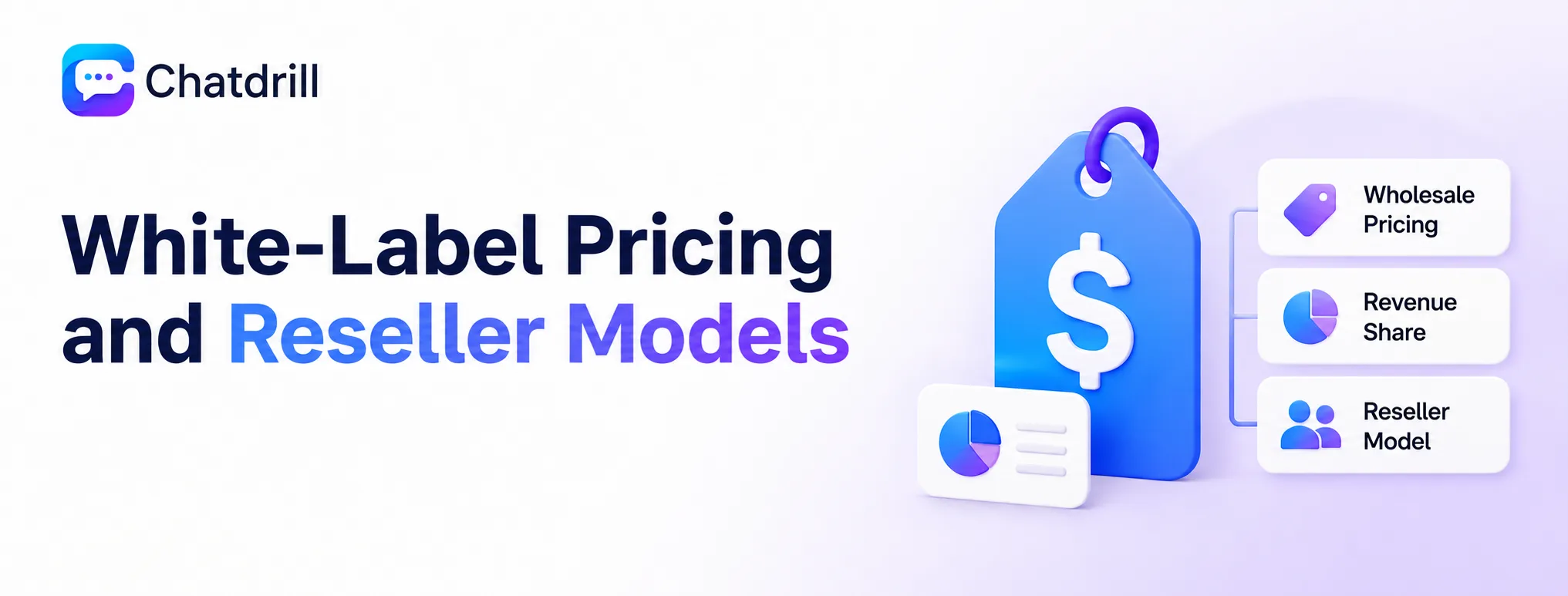
White-label pricing typically follows a wholesale-rate or revenue-share structure, with the right model
depending on whether an agency prefers predictable fixed costs or a variable cost tied directly to what it charges clients.
Wholesale-rate pricing
Under a wholesale model, an agency pays a fixed rate per client instance and marks up the price charged to that client, keeping the margin entirely under the agency's control.
This structure suits an agency with confidence in its ability to sell the service consistently, since the fixed cost applies regardless of how much markup is actually captured.
Revenue-share pricing
Under a revenue-share model, the platform takes a percentage of what the agency charges the client, aligning platform cost directly with actual revenue generated.
This structure reduces risk for an agency still validating demand, since cost scales with actual revenue rather than requiring upfront commitment per client instance.
Choosing the right model for your agency
An agency with predictable, established client demand often benefits more from wholesale pricing's potential for higher margin at scale, while a newer or more variable agency benefits from revenue-share's lower risk.
Discussing both options directly with a platform's sales team, rather than assuming only one model is available, often reveals more flexibility than initially advertised.
What to Plan for Before Adopting White-Label Chat Across Clients
Before rolling white-label chat out across a client base, pilot with one or two clients first, document a repeatable deployment process, and confirm support responsibilities are clearly divided between the agency and the platform.
Piloting with one or two clients first
Rolling out to a small subset of clients before a full-scale deployment reveals any friction in the white-labeling, deployment process, or client-facing experience while the stakes are still low.
This pilot phase is worth treating seriously rather than rushing, since issues caught here are far cheaper to fix than ones discovered after a full client-base rollout.
Documenting a repeatable deployment process
Creating a clear, step-by-step internal process for onboarding each new client onto the white-label platform keeps deployment consistent and efficient as the agency scales this offering.
This documentation also makes it easier to delegate deployment work to team members beyond whoever initially set up the platform relationship.
Clarifying support responsibilities
Establish clearly whether the agency or the underlying platform handles technical support when something goes wrong for a specific client, avoiding confusion during an actual support incident.
This division of responsibility is worth confirming explicitly with the platform before rollout, rather than discovering ambiguity during a live client issue.