
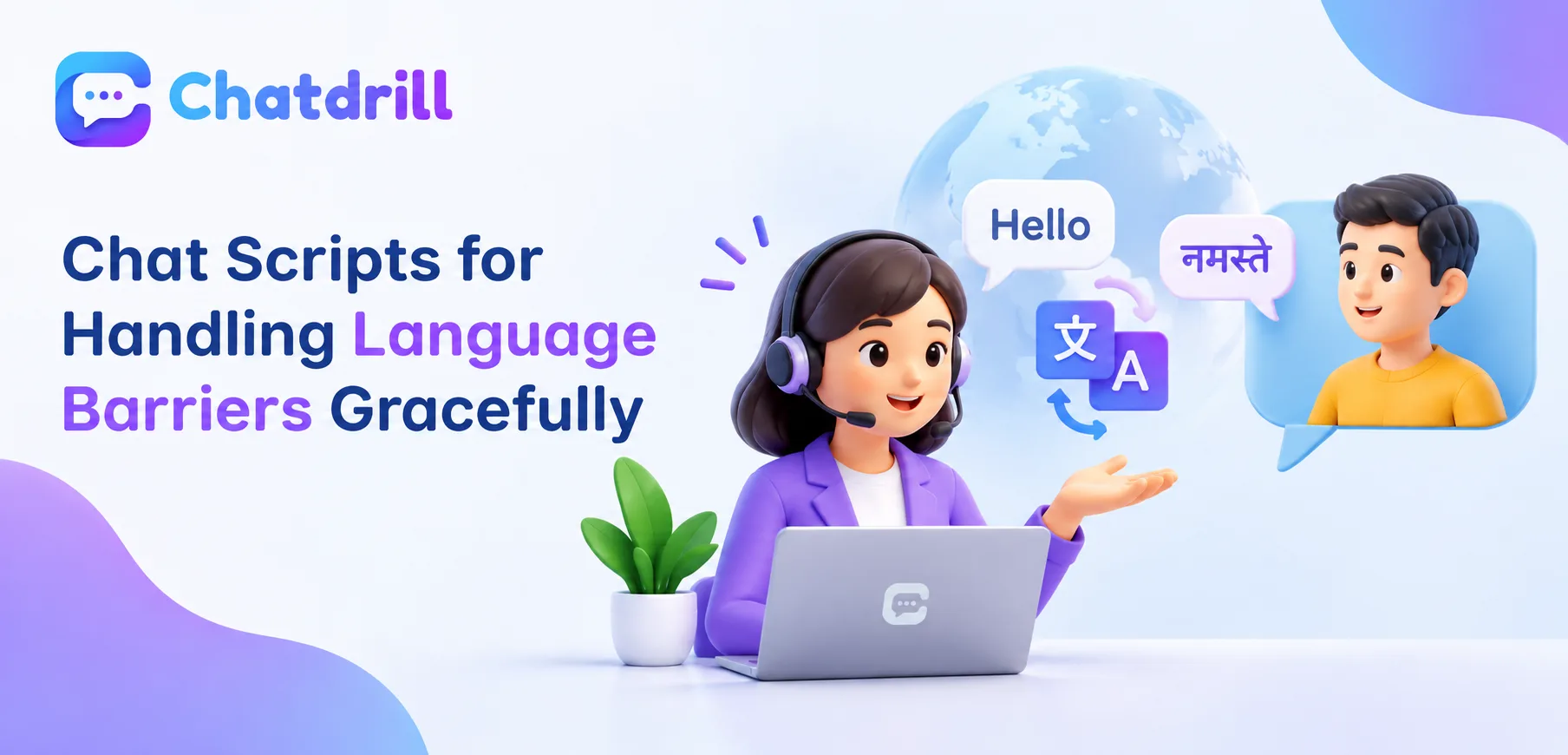
A language barrier in chat presents a genuine communication challenge, but how that challenge gets handled meaningfully shapes whether the customer feels genuinely supported or further frustrated by the interaction.
Quick answer: Effective scripts for handling a language barrier acknowledge the difficulty warmly, offer translation or a simpler language option immediately, and avoid any tone of frustration or condescension, since a customer already navigating a language gap needs reassurance that genuine help remains fully available despite the communication challenge.
Effective scripts for this scenario prioritize warmth and practical solutions, offering translation or simplified language immediately, rather than any hint of frustration or a dismissive tone.
This guide provides adaptable scripts for navigating language barriers gracefully, along with the reasoning behind why tone matters as much as the practical translation solution itself.
This guide covers warm acknowledgment and translation-offer scripts, simplifying language when needed, common mistakes, adapting to your customer base, and how ChatDrill supports multilingual chat.
Warm Acknowledgment and Translation-Offer Scripts
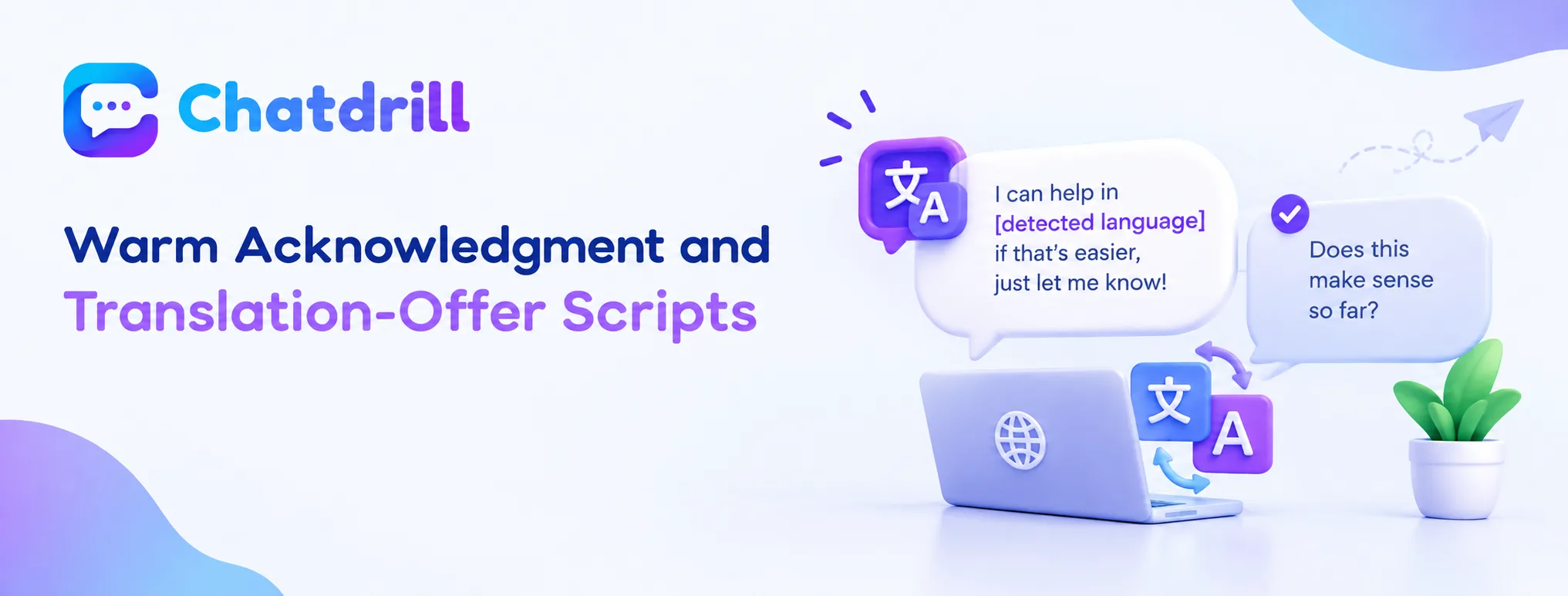
The first response to a detected language barrier should acknowledge it warmly and immediately offer a practical solution, rather than any hint of difficulty or frustration.
Offering translation immediately and warmly
"I can help in [detected language] if that's easier, just let me know!" offers a genuine, practical solution immediately and warmly, without any implication that the language difference is a problem to apologize for.
This immediate, solution-first response reassures the customer that the language difference doesn't reduce the quality of help available, addressing what's often a genuine underlying worry.
Confirming understanding after switching languages
"Just want to make sure I'm explaining this clearly, does this make sense so far?" checks in genuinely on comprehension after switching languages, respecting that translation quality can vary and confirming understanding matters more than simply completing the exchange.
This check-in habit protects against a translated explanation technically being delivered while genuine understanding still didn't actually occur.
Simplifying Language When Full Translation Isn't Available
When full translation capability isn't available, using simpler, clearer language and visual aids can still bridge much of the communication gap.
Using simpler, clearer phrasing
"I'll keep this simple: your order ships tomorrow. You'll get an email with tracking." uses short, clear sentences and avoids idioms or complex phrasing that could be genuinely harder to follow across a language gap.
This simplification approach helps even without formal translation capability, since clear, direct language is inherently more accessible than complex or idiomatic phrasing regardless of the reader's native language.
Using visual aids or numbered steps where helpful
"Here are the steps: 1) Click here 2) Enter your order number 3) Click submit" breaks a process into clear, numbered steps that are easier to follow across a language gap than a dense paragraph of prose.
This structural approach, distinct from the language itself, can meaningfully improve comprehension regardless of the specific language challenge involved.
Common Mistakes When Facing a Language Barrier
Any tone of frustration or impatience, and assuming a lack of response means a lack of understanding rather than a translation delay, are the most common mistakes.
Any hint of frustration or impatience
Even a subtle tone shift suggesting frustration with the communication difficulty can feel genuinely hurtful to a customer already navigating a challenging language gap, undermining trust regardless of how well the actual translation or simplification is handled.
Maintaining consistent warmth throughout, regardless of how many clarification rounds are genuinely needed, protects the customer relationship even through a more effortful exchange.
Assuming silence means lack of understanding
A brief pause while a customer reads a translated message or composes a response in a non-native language doesn't necessarily mean confusion, and jumping to re-explain prematurely can feel patronizing.
Allowing genuine space for the natural additional time a language barrier interaction often requires respects the customer's own pace rather than assuming difficulty prematurely.
Adapting Your Approach to Your Customer Base
Understanding which languages your customer base most commonly needs, and preparing accordingly, produces a more genuinely proactive, well-prepared language support approach.
Identifying your genuinely common language needs
Reviewing your own customer data or support history reveals which languages come up often enough to warrant more dedicated preparation, translation resources, or bilingual staffing, rather than treating every language need as an equally rare exception.
This data-informed preparation helps a business genuinely serve its actual customer base's real, recurring language needs rather than only reacting improvisationally each time.
Preparing key resources in your common secondary languages
Translating your most important, frequently referenced resources, key policies, common