

A business receiving many chat conversations daily faces a genuine prioritization challenge, since not every conversation represents an equally promising sales opportunity, yet manually reviewing and prioritizing each one individually doesn't scale as volume grows.
Quick answerChatdrill scores leads automatically by evaluating signals like stated intent, specific questions asked, and engagement depth during a conversation, then routes higher-scoring, genuinely promising leads to the appropriate sales team member while lower-priority inquiries continue through standard support handling, helping a business focus limited sales attention where it's genuinely most likely to pay off.
Understanding how Chatdrill's automatic lead scoring and routing works helps a business trust the system's prioritization judgment and configure it appropriately to reflect what genuinely matters most for their specific sales process.
This guide covers what signals inform lead scoring, how routing decisions get made, common configuration mistakes, and how to refine this system for your business over time.
What Signals Inform Lead Scoring
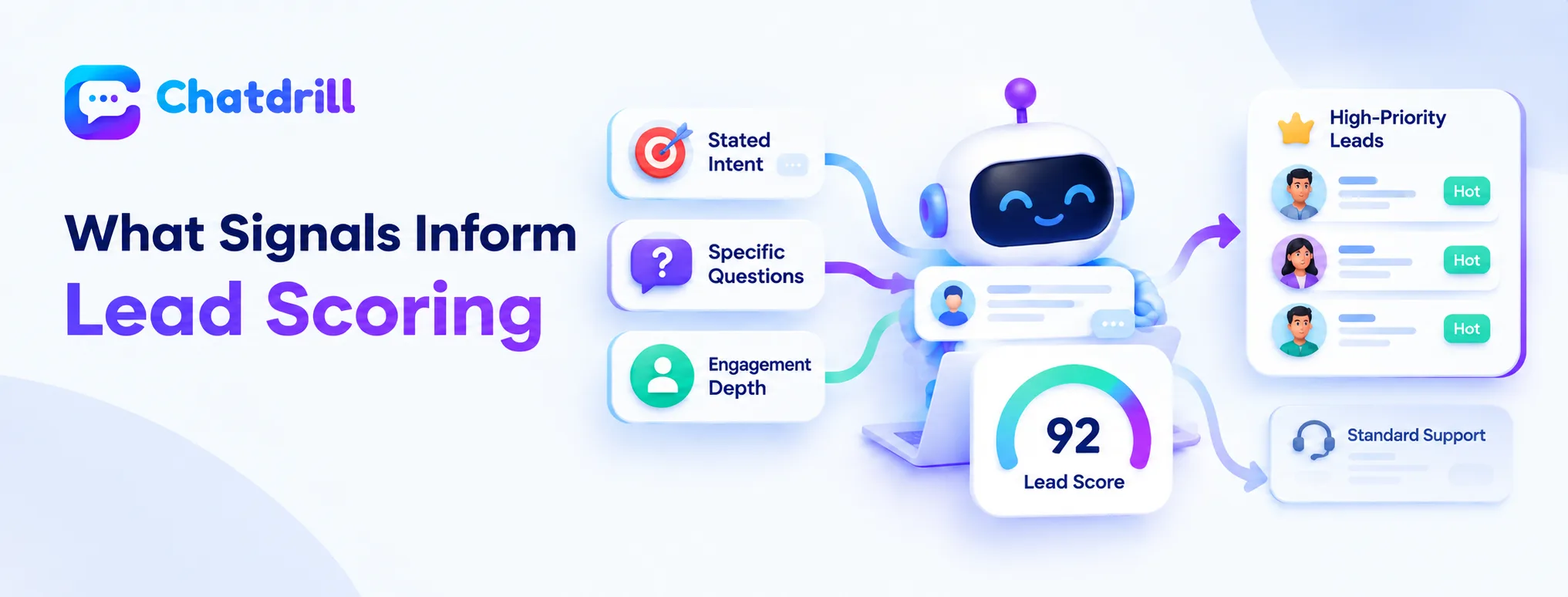
Stated intent, specific questions asked, and genuine engagement depth together inform a lead's score, reflecting real signals of purchase readiness.
Stated intent and specific questions
A conversation where a visitor explicitly states purchase intent, asks about pricing for a specific plan, or requests a demo carries genuinely stronger buying signals than a conversation limited to general, exploratory browsing questions.
This distinction reflects real, meaningful differences in where a prospect likely sits in their decision process, information genuinely worth incorporating into how a lead gets prioritized.
Genuine engagement depth
A longer, more substantive conversation involving multiple specific questions generally signals deeper genuine interest than a brief, single-question exchange, though this signal works alongside intent-based signals rather than replacing them entirely.
Combining engagement depth with stated intent produces a more genuinely reliable overall score than relying on either signal type alone.
How Routing Decisions Get Made

Higher-scoring leads route to appropriate sales team members while lower-priority inquiries continue through standard support handling.
Routing higher-scoring leads to sales
A conversation scoring above your configured threshold routes to an appropriate sales team member, potentially matched by product interest, territory, or account size depending on how your specific routing rules are configured.
This routing ensures your sales team's attention concentrates on the conversations genuinely most likely to convert, rather than being spread evenly across every incoming inquiry regardless of its actual promise.
Standard handling for lower-priority inquiries
A conversation that doesn't meet the scoring threshold for sales routing continues through standard support or AI-assisted handling, ensuring it still receives genuine, appropriate attention without unnecessarily consuming limited sales team capacity.
This tiered approach respects that every conversation deserves a genuinely appropriate response, even when that response doesn't specifically involve dedicated sales attention.
Common Configuration Mistakes
Setting scoring thresholds without reference to your own actual conversion data, and never revisiting routing rules, are common configuration mistakes.
Setting thresholds without reference to your own data
Configuring a scoring threshold based on a generic assumption, rather than reviewing which of your own actual past conversations led to genuine conversions, risks a threshold poorly calibrated to your specific business's real patterns.
Reviewing your own historical conversation and conversion data before finalizing thresholds produces a more genuinely accurate, business-specific configuration.
Never revisiting routing rules
Routing rules configured once and never revisited can gradually drift out of alignment as your sales team structure, product lineup, or genuine priorities evolve over time.
Periodically reviewing routing rules against your current, actual business structure keeps this system genuinely aligned with how your sales process actually works today.
Refining This System for Your Business Over Time
Reviewing actual conversion outcomes by score tier and adjusting signal weighting based on genuine results keeps lead scoring accurate as your business evolves.
Reviewing conversion outcomes by score tier
Tracking whether leads scored highly actually convert at a meaningfully higher rate than lower-scored leads confirms whether your scoring configuration is genuinely capturing real purchase-readiness signals.
This outcome-based validation is what separates a genuinely working scoring system from one that merely appears sophisticated without actually predicting real conversion behavior.
Adjusting signal weighting based on genuine results
If a specific signal, engagement depth, a particular stated intent phrase, proves more or less predictive than initially assumed based on your own actual conversion data, adjusting its weighting accordingly improves the system's genuine accuracy over time.
This ongoing refinement reflects the same evidence-based improvement principle worth applying across any configurable aspect of an AI-assisted system.
How This Fits Into Your Broader Sales Process
Automatic scoring and routing works best as one input feeding into your existing sales process, not a fully autonomous replacement for sales team judgment.
A feeding input, not a replacement for judgment
Treating a routed lead's score as a helpful, evidence-based prioritization signal, rather than the sole basis for how a sales representative approaches the conversation, respects that human judgment still adds genuine value once a promising lead reaches a real person.
This framing keeps the automatic system in its genuinely appropriate role, surfacing and prioritizing opportunities, while leaving actual relationship-building and closing to human sales expertise.
Coordinating with your existing CRM and sales workflow
Ensuring routed leads flow smoothly into your existing CRM and sales workflow, rather than creating a separate, disconnected process, helps your sales team incorporate this system naturally into how they already work.
This integration consideration matters for genuine adoption, since a system that creates extra manual work to reconcile with existing tools is less likely to be used consistently and effectively.
Catch buyers while they are on the pricing page and book the meeting in the chat.
See how it works