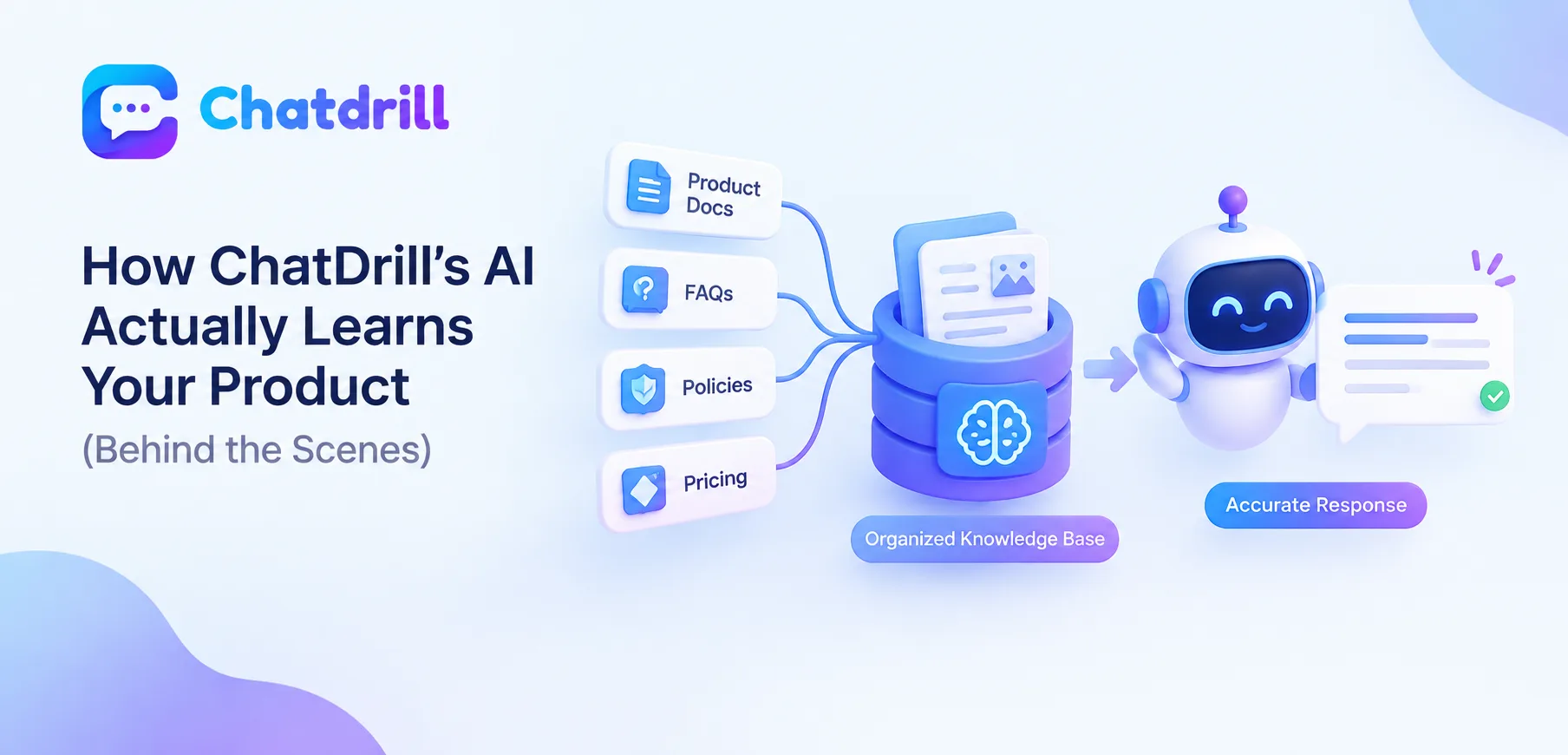
A common question about any AI-assisted chat product is genuinely reasonable to ask: how does the AI actually come to know your specific product, policies, and pricing well enough to answer customer questions accurately?
Quick answerChatdrill's AI learns your product by ingesting your actual business content, documentation, FAQs, policies, and product details, then organizing this material so it can retrieve and reference the genuinely relevant piece of information for a specific customer question, a process closer to building a well-organized, searchable knowledge base than teaching the AI facts from scratch.
Understanding this process at a conceptual level, without needing deep technical expertise, helps a business set up Chatdrill more effectively and know what kind of source material genuinely improves the AI's accuracy over time.
This guide covers how the ingestion and organization process works, what makes source content genuinely useful for this process, common setup mistakes, and how to keep this training current as your business evolves.
How the Ingestion and Organization Process Works
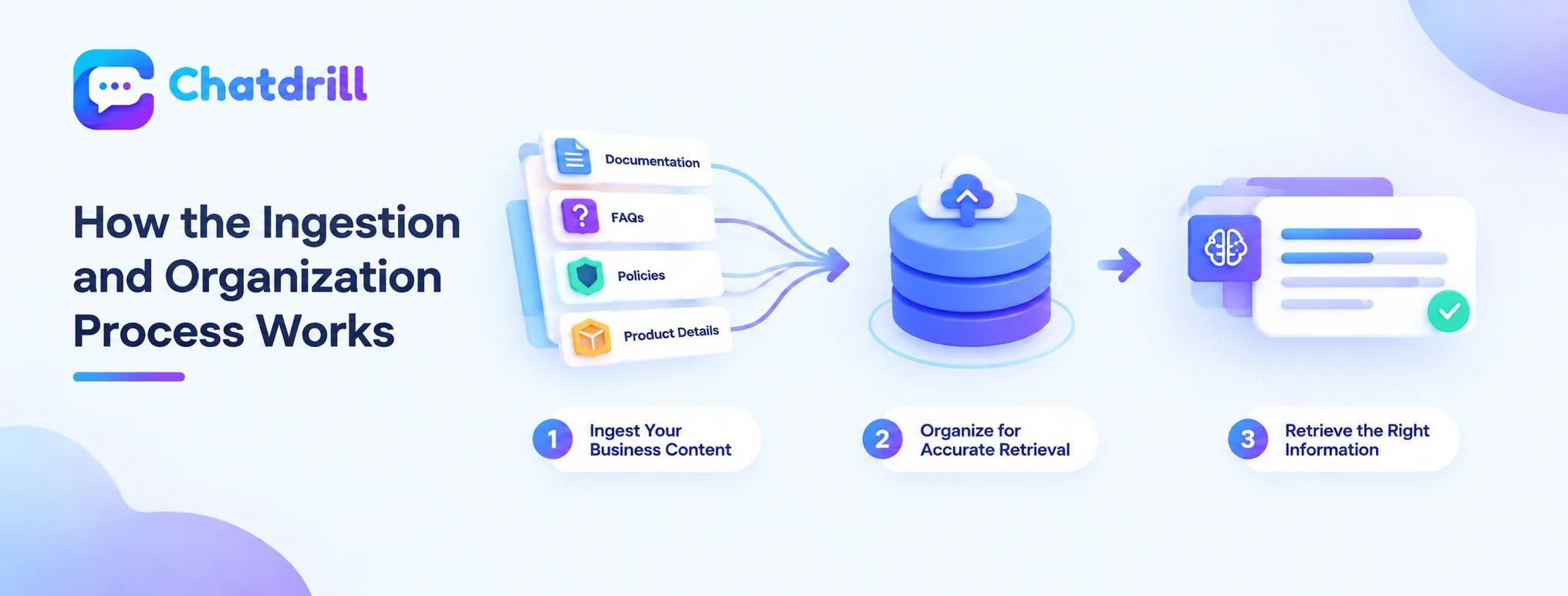
Chatdrill's AI ingests your actual business content and organizes it so it can retrieve the specific, relevant piece of information for a given customer question.
Ingesting your genuine business content
Chatdrill's AI is set up by ingesting your actual documentation, FAQs, policies, and product details, the same genuine source material a well-trained human agent would eventually learn, rather than starting from generic, external assumptions about your specific business.
This grounding in your own genuine content is what allows the AI to provide business-specific, accurate answers rather than generic responses that could apply to any similar business.
Organizing content for accurate retrieval
Once ingested, this content gets organized so the AI can retrieve the genuinely relevant piece of information for a specific customer question, similar in spirit to how a well-organized internal knowledge base helps a human agent quickly find the right answer rather than searching blindly.
This retrieval-based approach is why the quality and organization of your source content directly affects how accurately the AI can answer a given question, a well-organized knowledge base produces more reliable retrieval than a disorganized one. A chatbot built this way is often described as a RAG chatbot, short for retrieval-augmented generation.
What Makes Source Content Genuinely Useful
Clear, specific, and current content produces meaningfully better AI accuracy than vague, outdated, or overly general source material. Content quality is also central to the wider question of whether AI support is getting better in practice.
Clarity and specificity in source content
Genuinely clear, specific documentation, exact policy terms, precise product specifications, produces more accurate AI responses than vague or ambiguous source material that leaves room for misinterpretation.
This specificity requirement mirrors the same principle relevant to training a new human employee, clear, unambiguous source material produces more reliable, consistent understanding.
Currency and completeness
Content that's genuinely current and reasonably complete, covering your actual common questions rather than significant gaps, gives the AI a more comprehensive, accurate foundation to draw from.
This completeness matters directly for the AI's ability to actually resolve a customer's question, rather than only partially addressing it due to a genuine gap in the underlying source material.
Common Setup Mistakes
Providing insufficient or outdated source content, and never reviewing which questions the AI struggles with, are common mistakes that limit AI accuracy.
Insufficient or outdated source content
Providing only minimal source content, or content that hasn't been updated as your business evolved, limits how accurately the AI can genuinely answer current, real customer questions.
Investing genuine effort in comprehensive, current source content upfront, as this guide's earlier section recommends, directly prevents this common, foundational limitation.
Never reviewing struggling question patterns
Failing to review which specific questions the AI handles less accurately misses the opportunity to identify and fill genuine content gaps that would meaningfully improve overall performance.
Establishing a regular review habit specifically for this feedback loop, covered further in this guide's maintenance section, ensures ongoing accuracy improvement rather than a static, unrefined initial setup.
Keeping Training Current as Your Business Evolves
Regularly updating source content as your business changes, and reviewing genuine performance data, keeps the AI's accuracy current over time.
Regular content updates as your business changes
Updating your source content whenever a genuine business change occurs, a new product, an updated policy, a pricing change, keeps the AI's underlying knowledge current rather than allowing it to gradually drift from your actual, present business reality.
This ongoing maintenance reflects the same principle relevant to any knowledge base, content accuracy naturally decays over time without deliberate, regular upkeep.
Reviewing genuine performance data for gaps
Reviewing actual conversation data for questions the AI handled less accurately reveals genuine, specific content gaps worth addressing, turning real usage patterns into a systematic improvement process.
This data-driven refinement approach produces more targeted, effective improvement than a generic, unfocused content review disconnected from actual observed performance.
How This Compares to Training a New Human Employee
The genuine parallels, and the important differences, between AI training and onboarding a new team member help set realistic expectations for this process.
Genuine parallels worth recognizing
Both a new human employee and Chatdrill's AI genuinely benefit from clear documentation, real examples of past customer interactions, and a feedback loop identifying where their understanding falls short, reflecting the same underlying learning principles.
Recognizing this parallel helps a business apply intuitions it likely already has about effective onboarding to the genuinely analogous process of setting up AI training.
Important differences worth keeping in mind
Unlike a human employee who can ask a clarifying question mid-conversation when something is genuinely ambiguous, the AI's accuracy depends entirely on the clarity of what was provided during setup, making upfront content quality even more consequential.
This difference reinforces why the specificity and completeness this guide identifies as important deserve genuine, deliberate attention rather than being treated as optional refinement.
Let AI answer the repeat questions from your own content, and hand off to a person when it should.
See how it works