

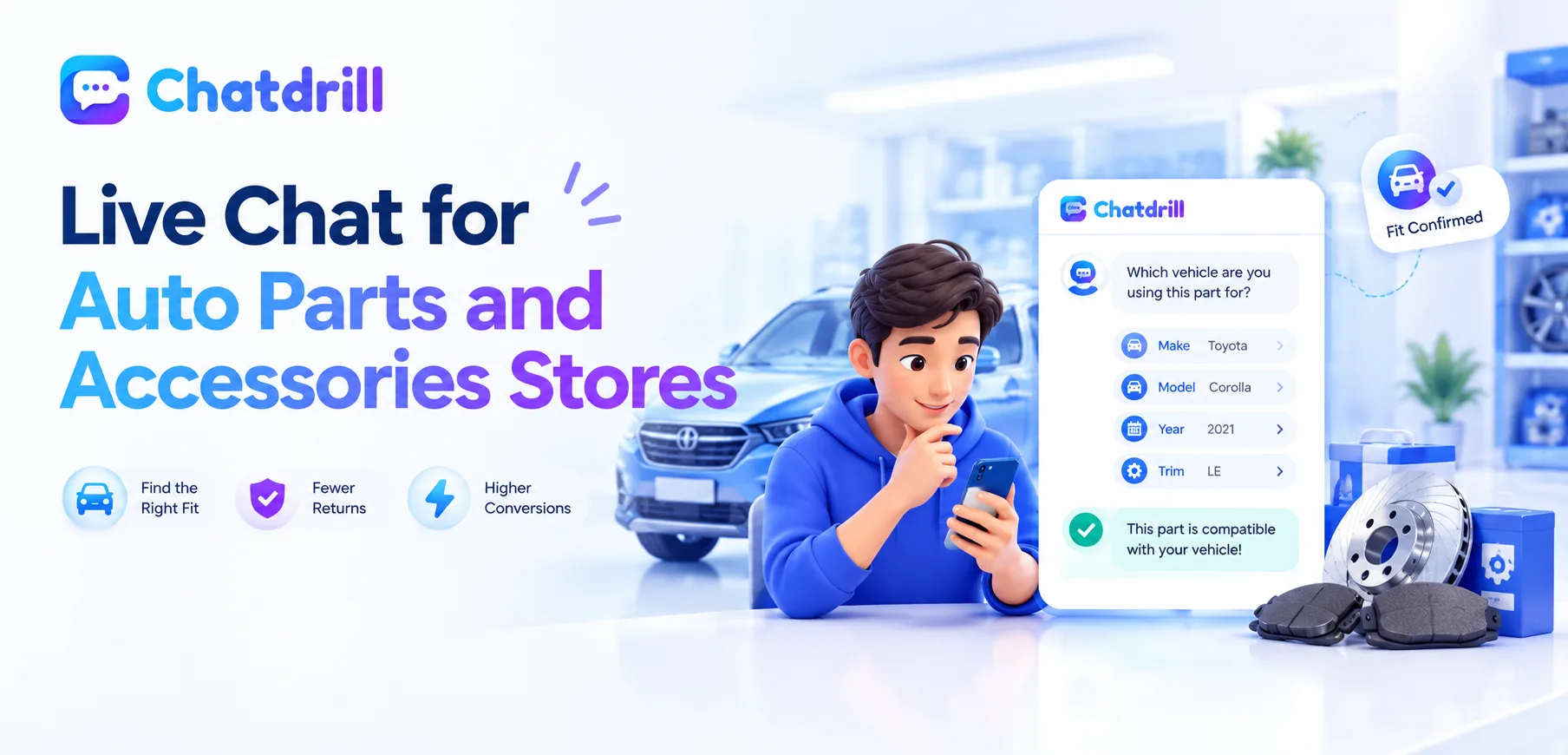
Auto parts ecommerce presents a genuinely specific challenge distinct from most product categories, since a part's compatibility with a customer's exact vehicle depends on precise make, model, year, and sometimes trim-level details that a customer may not fully know or correctly identify on their own.
Quick answer: Live chat helps auto parts and accessories stores resolve the single most common source of purchase hesitation and returns in this category, genuine uncertainty about whether a specific part fits a customer's exact vehicle make, model, and year, by providing fast, accurate compatibility confirmation before checkout rather than after a wrong part arrives.
Live chat directly addresses this compatibility uncertainty, letting a customer confirm fit before purchasing rather than discovering an incompatibility only after receiving the wrong part, a pattern that drives a significant share of this category's returns.
Understanding this specific compatibility challenge, and the tactics that resolve it most effectively, helps an auto parts business meaningfully reduce both lost sales from unresolved uncertainty and costly compatibility-related returns.
This guide covers the compatibility challenge this category presents, tactics for resolving it, common mistakes, measuring the actual impact, and how ChatDrill supports auto parts and accessories stores.
The Compatibility Challenge This Category Presents
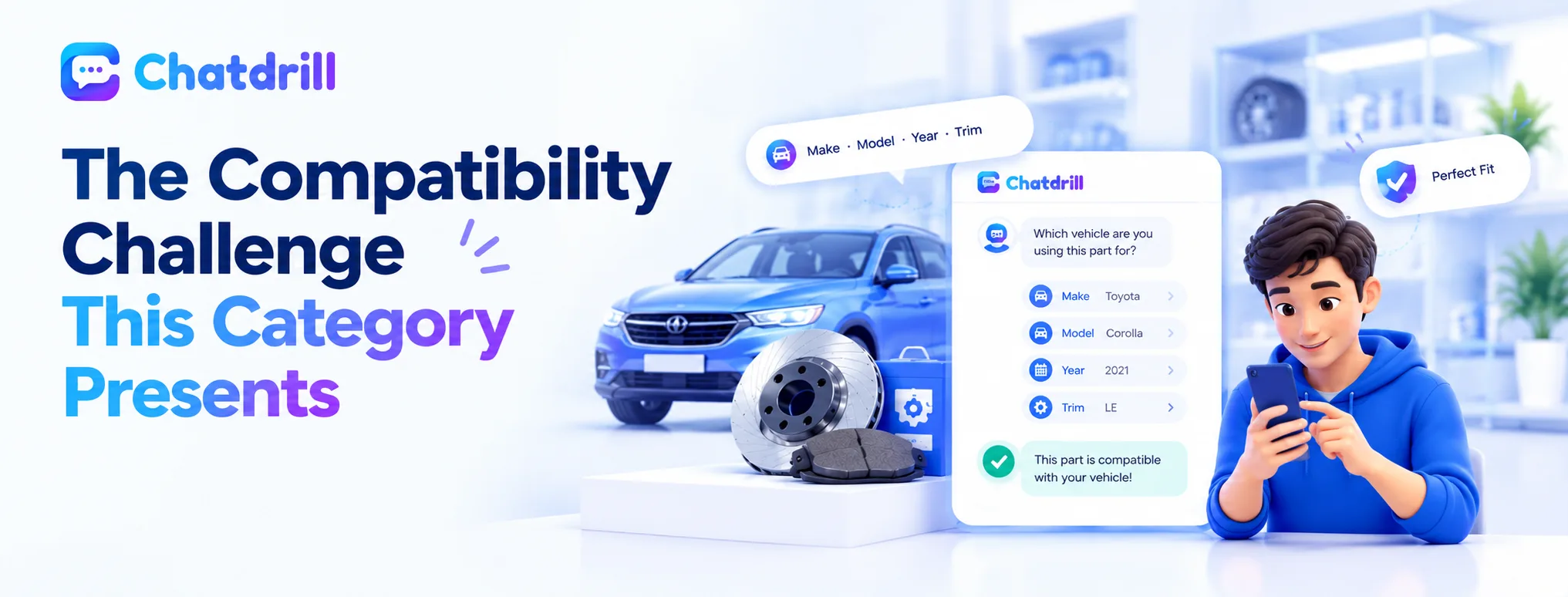
Precise vehicle compatibility, dependent on exact make, model, year, and sometimes trim details, represents this category's single most significant source of both hesitation and returns.
Why compatibility uncertainty is this category's core challenge
A customer uncertain whether a specific part genuinely fits their exact vehicle configuration often either abandons the purchase entirely or, worse, purchases an incompatible part that results in a costly return and a frustrating experience.
This uncertainty is genuinely more consequential here than in most other ecommerce categories, since an incorrect purchase typically can't simply be exchanged for a slightly different size the way clothing or many other products can.
Why customers often can't self-resolve this uncertainty
A customer frequently doesn't know their vehicle's exact trim level or specific configuration details relevant to precise part compatibility, meaning even a diligent customer attempting to verify fit independently may still make an incorrect selection.
This genuine knowledge gap is precisely why real-time, interactive chat guidance delivers particularly high value in this specific category compared to a static compatibility chart alone.
Tactics for Resolving Compatibility Uncertainty
Asking specific vehicle identification questions and confirming compatibility explicitly before checkout both directly address this category's core challenge.
Asking specific vehicle identification questions
"Can you share your vehicle's exact year, make, model, and if you know it, trim level?"
gathers the specific detail genuinely needed to confirm compatibility accurately, rather than relying on a customer's potentially incomplete self-assessment.
This specific question set reflects the genuine technical precision this category's compatibility determination requires, beyond a customer's general description of their vehicle.
Explicit compatibility confirmation before checkout
"Confirmed, this part is compatible with your [specific vehicle details]." provides explicit, confident confirmation before the customer completes purchase, directly preventing the compatibility-related returns this category commonly experiences.
This explicit confirmation step, rather than leaving compatibility as an assumption, protects both the customer's experience and the business's return rate.
Common Mistakes in Auto Parts Chat
Confirming compatibility based on incomplete vehicle information, and failing to account for trim-level or configuration variations, are common mistakes.
Confirming compatibility with incomplete information
Confirming a part's compatibility based only on general make and model, without accounting for genuinely relevant trim-level or configuration variations, risks a confident-sounding but ultimately incorrect confirmation.
Gathering the fully specific vehicle detail this guide's tactics recommend, before offering confirmation, avoids this particular, credibility-damaging mistake.
Overlooking trim-level and configuration variations
Assuming all vehicles of a given make, model, and year share identical part compatibility, without accounting for genuine trim or configuration differences that affect actual fit, produces an unreliable confirmation for certain, more variable parts.
Training chat AI or staff to recognize when a specific part category genuinely requires this additional trim-level detail protects against this specific, category-relevant risk.
Measuring the Actual Impact for Your Business
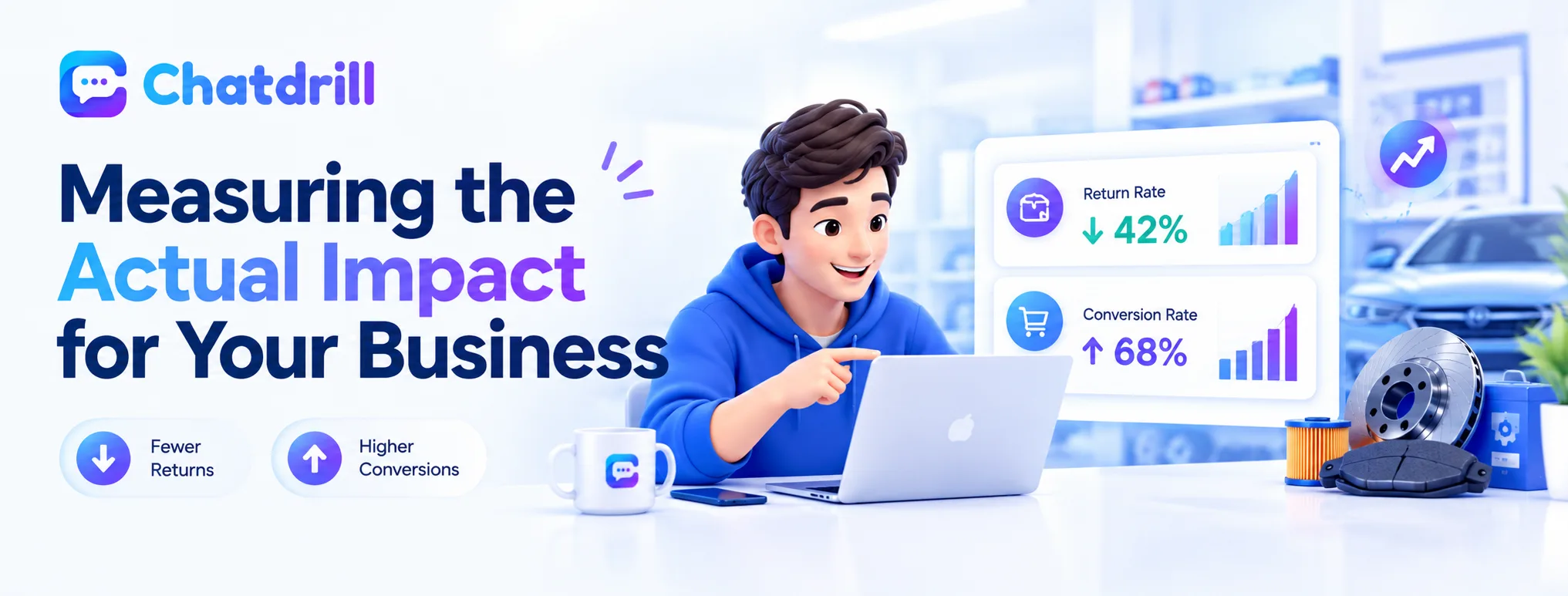
Tracking compatibility-related return rate reduction and chat-assisted conversion together reveal chat's genuine contribution to this category's specific challenge.
Compatibility-related return rate reduction
Tracking whether your compatibility-related return rate genuinely decreases after implementing thorough chat-based compatibility confirmation provides direct evidence of chat's specific contribution to this category's most significant return driver.
This category-specific return tracking matters more than a generic overall return rate metric that wouldn't isolate this particular, addressable cause.
Chat-assisted conversion for compatibility-uncertain purchases
Tracking conversion specifically for purchases where a customer expressed genuine compatibility uncertainty before engaging with chat reveals chat's direct contribution to resolving hesitation that would otherwise likely result in an abandoned purchase.
This targeted measurement captures chat's genuine value specifically for the uncertainty this guide identifies as central to this category's purchase decision.