
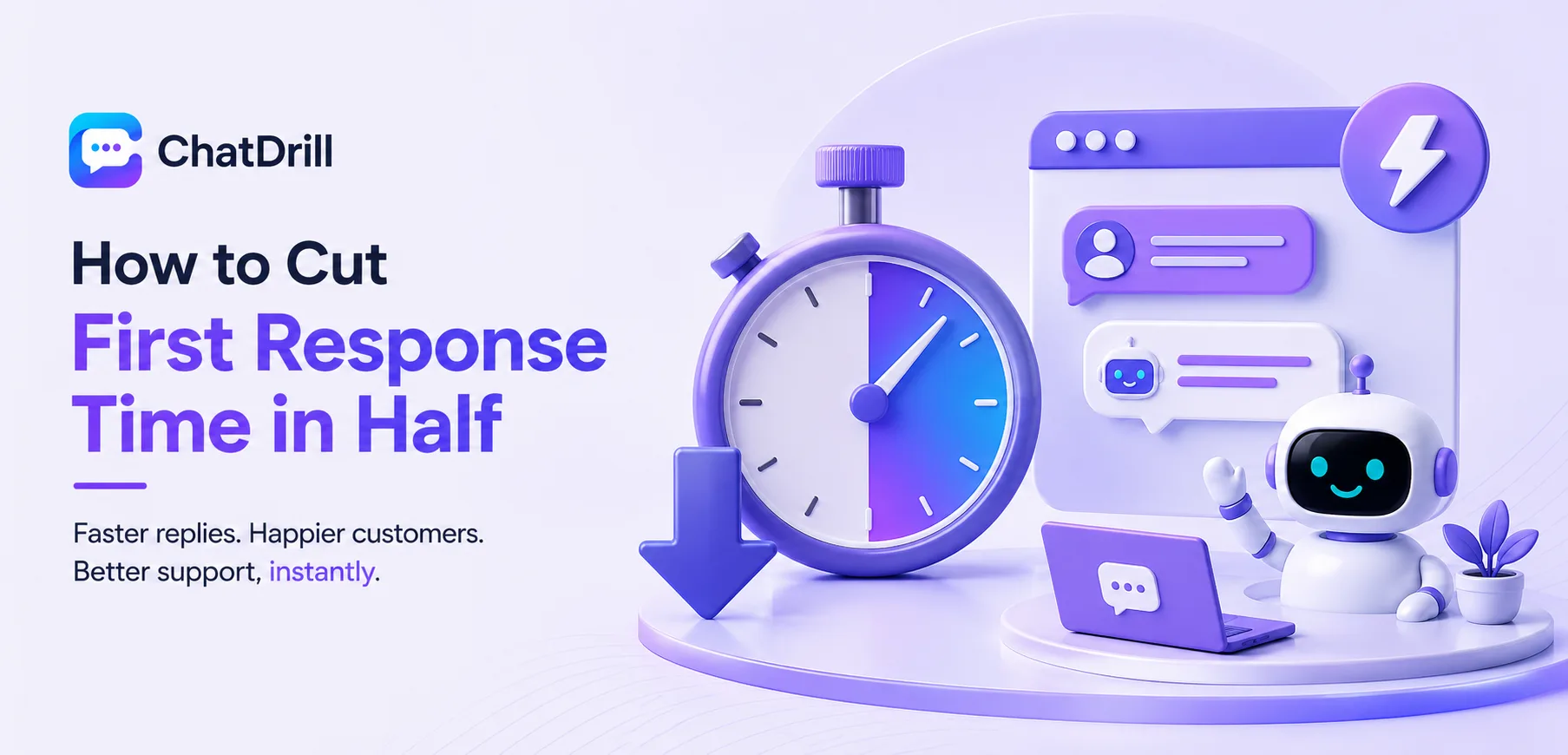
First response time is one of the metrics most directly tied to customer satisfaction, and it's also one of the most responsive to deliberate, focused effort compared to a metric like resolution time that depends more on genuine issue complexity.
Cutting this number meaningfully in half rarely comes from one silver-bullet change, it typically comes from combining AI-driven instant answers for routine questions, smarter routing logic, and proactive engagement that gets ahead of a visitor's question entirely.
The businesses that see the clearest improvement approach this systematically, identifying exactly where delay currently accumulates before applying the right fix to each specific bottleneck.
This guide covers where response time delay typically accumulates, the levers that deliver the most impact, a practical implementation approach, and mistakes worth avoiding.
Quick answer: Cutting first response time in half typically requires a combination of AI handling routine questions instantly, smarter routing that gets a conversation to the right agent faster, and proactive triggers that engage a visitor before they even have to ask, rather than any single change alone.
Where First Response Delay Typically Accumulates
Response delay commonly accumulates from routine questions unnecessarily waiting for a human, inefficient routing that doesn't reach the right agent quickly, and a lack of proactive engagement that could have gotten ahead of the question.
Routine questions waiting for humans
A significant share of typical chat volume consists of routine, repetitive questions that don't genuinely require human judgment, yet without AI handling, these still queue and wait like any other conversation.
This category represents one of the most straightforward, highest-impact opportunities for response time improvement.
Inefficient routing delays
A conversation that has to pass through multiple queues or handoffs before reaching someone equipped to actually help accumulates delay at each transition point.
Streamlining this routing, getting a conversation to the right destination on the first attempt, removes accumulated delay that has nothing to do with actual resolution complexity.
Missed proactive engagement opportunities
A visitor who has to initiate a conversation and then wait for a response experiences more total delay than one who's proactively engaged before they even had to ask.
This missed opportunity represents genuine, addressable delay, distinct from the time it takes to actually answer a question once asked.
The Levers That Deliver the Most Impact

The highest-impact levers are AI handling routine questions instantly, streamlined routing logic, and proactive triggers that engage visitors before they initiate contact.
AI for instant routine-question resolution
Training AI thoroughly on your actual most common questions lets these resolve instantly, removing the queue-wait time that otherwise applies even to genuinely simple questions.
This lever alone often accounts for the largest single improvement, given how concentrated typical chat volume is in a relatively small set of recurring question types.
Streamlined, accurate routing
Configuring routing logic to correctly identify and direct a conversation to the right destination immediately, rather than through multiple handoffs, removes delay unrelated to actual resolution difficulty.
This improvement particularly benefits genuinely complex conversations, which shouldn't also carry the burden of inefficient routing on top of their inherent complexity.
Proactive engagement triggers
Reaching out to a visitor showing clear signals of needing help, hesitation on a specific page, repeated visits to the same section, before they initiate contact effectively eliminates their own wait time entirely.
This proactive approach shifts the response time equation in your favor, since the engagement happens before the traditional "first response" clock would have even started.
Implementation Approach for Cutting Response Time
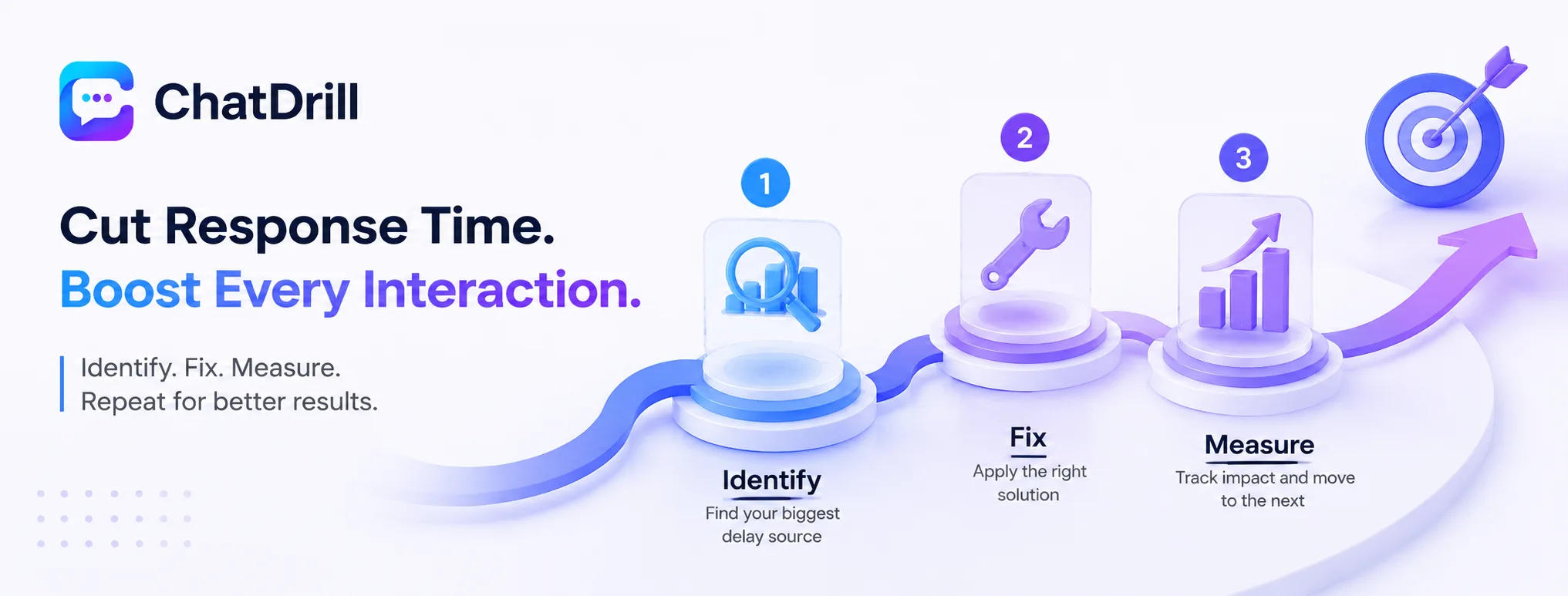
Step 1: Identify your current biggest delay source
Step 3: Measure impact and move to the next bottleneck
next bottleneck.
Step 1: Identify your current biggest delay source Reviewing your actual response time data, broken down by conversation type and routing path, reveals where delay is genuinely concentrated rather than assuming based on general impression.
This diagnostic step ensures your improvement effort targets the actual biggest opportunity rather than a secondary issue.
Step 2: Apply the corresponding fix
Addressing whichever bottleneck the data reveals as most significant, whether that's AI training gaps, routing inefficiency, or missed proactive opportunities, focuses effort where it delivers the most value.
Tackling one identified bottleneck at a time, rather than attempting every fix simultaneously, makes it possible to measure genuine impact from each specific change.
Step 3: Measure impact and move to the next bottleneck
Confirming the specific fix genuinely improved response time before moving to address the next largest remaining delay source keeps the improvement process systematic and verifiable.
This iterative approach compounds over time, addressing successive bottlenecks rather than attempting one comprehensive overhaul that's harder to measure and troubleshoot.
Common Mistakes When Trying to Cut Response Time
The most common mistakes are attempting every fix simultaneously without measuring individual impact, focusing only on AI while ignoring routing inefficiency, and setting an unrealistic target disconnected from your genuine starting point.
Attempting everything simultaneously
Implementing AI training, routing changes, and proactive triggers all at once makes it difficult to know which specific change actually drove any observed improvement.
Addressing bottlenecks sequentially, measuring each individually, produces more genuinely reliable insight into what's actually working.
Focusing only on AI while ignoring routing
Investing heavily in AI training while leaving inefficient routing logic unaddressed leaves genuine, addressable delay in place for exactly the complex conversations that still need human handling.
A comprehensive approach addressing both AI coverage and routing efficiency captures more of the available improvement than either alone.
Setting an unrealistic disconnected target
Aiming for an arbitrary target without grounding it in your actual current performance and realistic improvement potential can lead to either superficial fixes or discouragement when the target isn't reached.
Setting a target based on your specific diagnosed bottlenecks and realistic fix potential produces a more achievable, meaningful goal.
How ChatDrill Helps Cut First Response Time
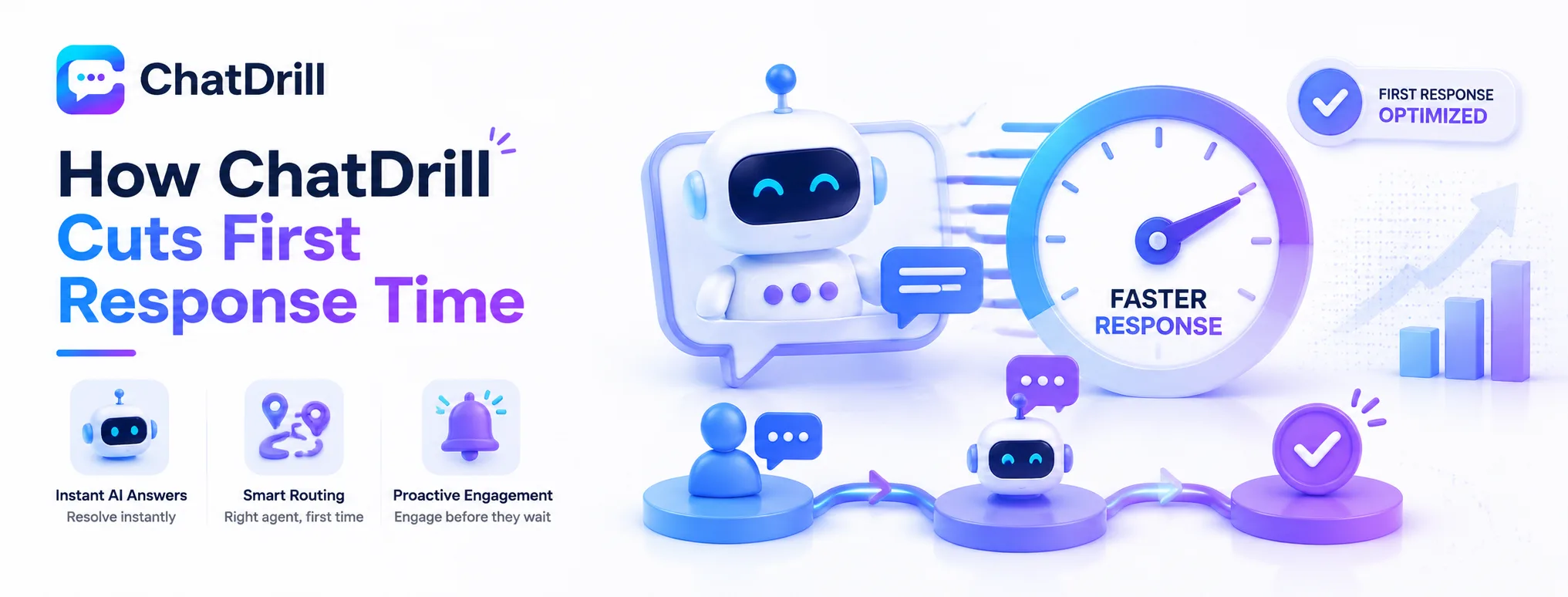
ChatDrill addresses all three major delay sources at once, instant AI answers for routine questions, configurable smart routing, and proactive triggers, giving a business a direct, measurable path to a faster first response time.
Instant AI resolution for routine volume
Training ChatDrill's AI on your most common questions lets a meaningful share of conversations resolve the moment they arrive, removing the queue-wait time that otherwise applies even to genuinely simple requests.
Because this training is visible and reviewable within the platform, you can directly see which question categories are resolving instantly and where further training would close remaining gaps.
This single lever is often the fastest way to move your overall first response time number, given how much typical chat volume concentrates in a relatively narrow set of repeat questions.
Smart routing and proactive triggers built in
ChatDrill's routing configuration lets you send a conversation directly to the right destination on the first attempt, avoiding the accumulated delay of multiple handoffs for genuinely complex issues.
Its proactive trigger settings let you engage a visitor based on real behavioral signals, effectively starting the conversation before the visitor would have had to wait at all.
Used together, these three levers, AI resolution, routing, and proactive engagement, address delay from multiple angles rather than relying on a single fix.