

Ecommerce support conversations concentrate heavily around a genuinely predictable set of categories, order status, shipping, returns, and product fit, making a well-built canned response library one of the highest-leverage investments an online retailer can make in support efficiency.
Quick answer: An effective ecommerce canned response library covers order status, shipping delays, returns, and sizing or product-fit questions, since these represent the highest-volume, most predictable question categories in online retail, letting a team resolve common questions quickly and consistently without sacrificing the personal, empathetic tone that keeps a canned response from feeling robotic.
The genuine challenge lies in building responses that resolve these questions quickly while still feeling personal and empathetic, since an obviously robotic canned response can undermine the trust a genuine, helpful interaction is meant to build.
This guide provides adaptable canned responses for ecommerce's most common categories, along with the reasoning behind why each is structured the way it is.
This guide covers order and shipping status responses, returns and product-fit responses, common mistakes, maintaining the library over time, and how ChatDrill supports ecommerce canned responses.
Order and Shipping Status Responses
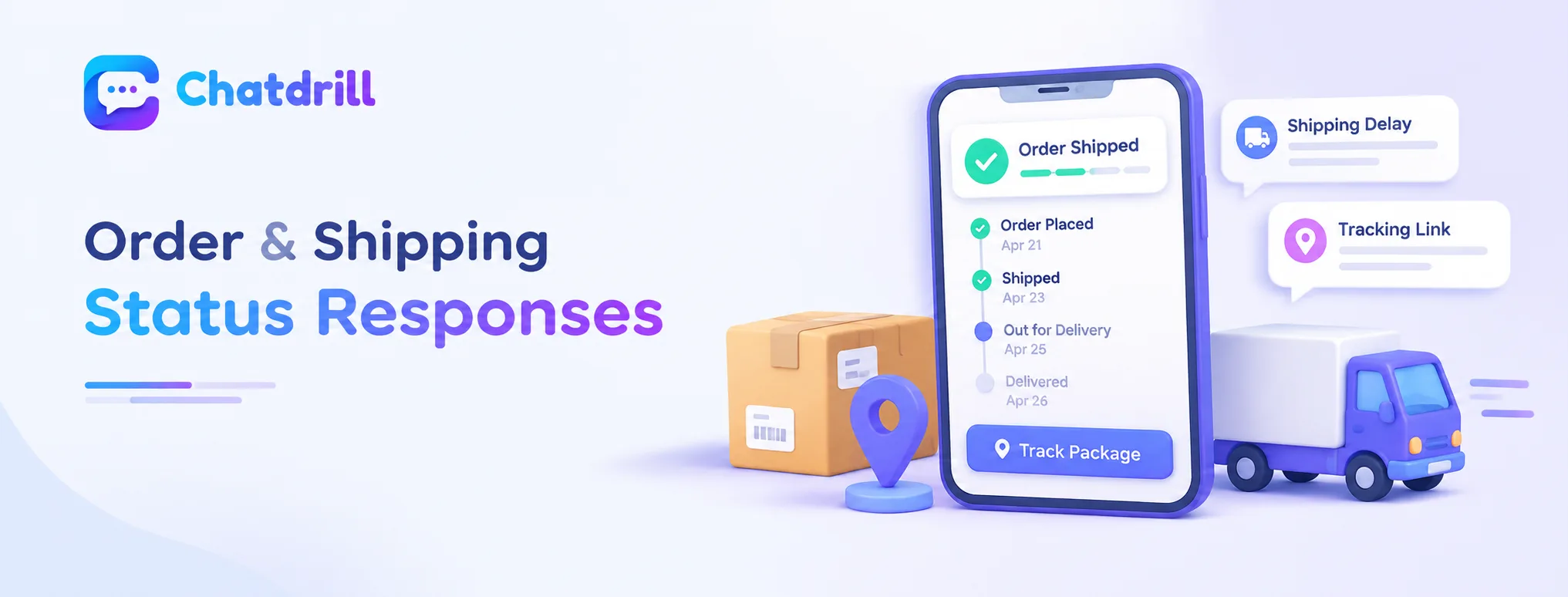
Order status and shipping delay responses should provide specific, actionable detail rather than a generic acknowledgment alone.
Order status response
"Your order [#] shipped on [date] and is currently [status], here's your tracking link: [link]. Expected delivery is [date]." provides genuinely complete, specific information in one response rather than requiring additional back-and-forth.
This completeness respects that a customer checking order status usually wants the full picture immediately, not a partial answer requiring a follow-up question.
Shipping delay response
"I'm sorry for the delay, your order is currently [status] and now expected by [updated date]. I'll keep an eye on it and let you know if anything changes." acknowledges the delay honestly while providing a specific, updated expectation.
This honesty, rather than a vague reassurance, respects the customer's genuine need for accurate planning information even when the news isn't ideal.
Returns and Prod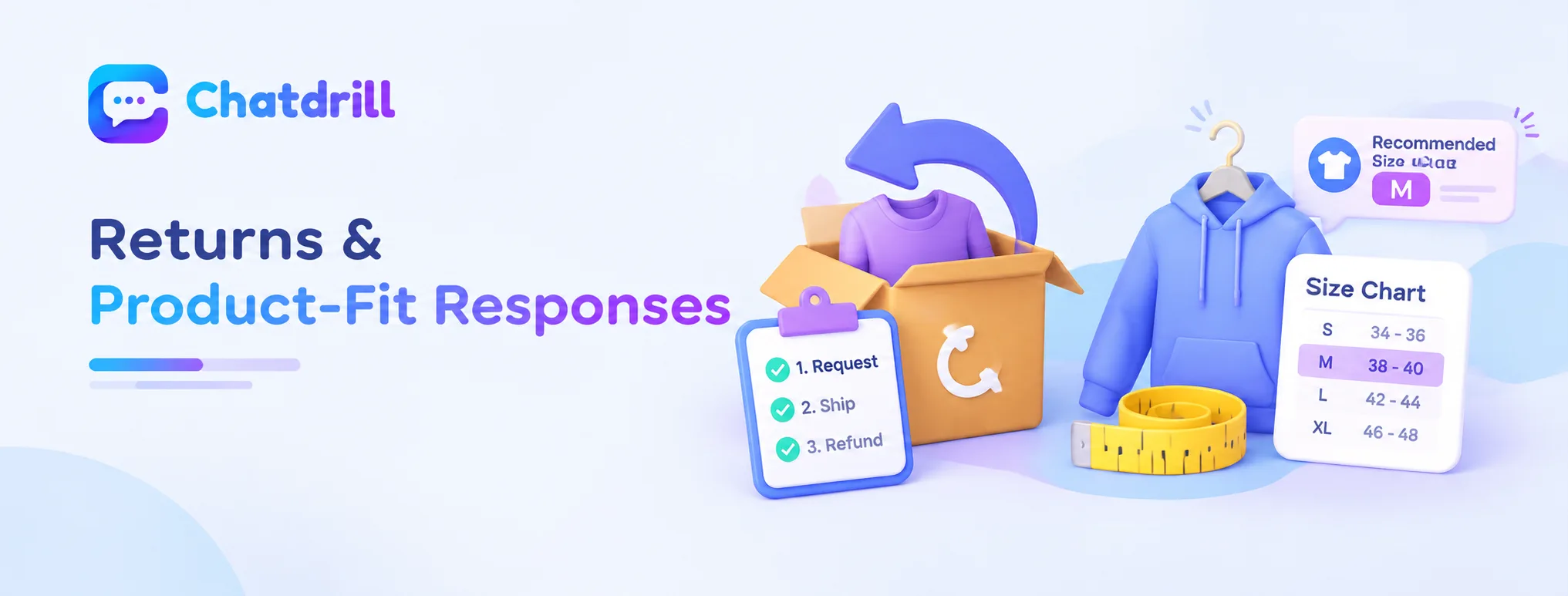 uct-Fit Responses
Clear return process guidance and empathetic, specific product-fit answers both address ecommerce's second-most-common question category effectively.
Return process guidance
"No problem, here's how to start your return: [specific steps/link]. Once we receive the item, your refund typically processes within [timeframe]." provides a clear, complete path forward rather than a vague acknowledgment alone.
This clarity reduces the follow-up questions a vaguer response would likely generate, improving overall resolution efficiency.
Product-fit and sizing guidance
"Based on our sizing chart, most customers with your measurements find [specific size] works best, though if you're between sizes, sizing up tends to be the safer choice for this particular item." provides genuinely useful, specific guidance rather than a generic size-chart referral alone.
This specificity directly helps prevent the fit-related returns that represent a meaningful share of typical ecommerce return volume.
Common Mistakes in Ecommerce Canned Responses
Responses that sound obviously robotic or generic, and failing to update responses as policies change, are common mistakes.
Obviously robotic or generic phrasing
A canned response using overly formal, corporate language, or clearly not adapted to the specific customer's actual question, can feel impersonal and undermine trust even while technically providing accurate information.
Writing canned responses in a genuinely warm, conversational tone, as this guide's examples demonstrate, preserves a personal feel even when the underlying content is reused across many conversations.
Outdated responses after policy changes
A canned response referencing an old return window, outdated shipping carrier, or superseded policy detail creates genuine confusion and potential customer frustration when it no longer reflects current, accurate practice.
Establishing a regular review habit specifically for canned responses tied to policies that change periodically prevents this specific, easily overlooked source of inaccuracy.
Maintaining Your Library Over Time
Reviewing which responses get used most and periodically refreshing language keeps the library genuinely useful as your business evolves.
Reviewing usage patterns to prioritize maintenance
Identifying which canned responses get used most frequently helps prioritize where accuracy review and refinement effort delivers the most value, rather than treating every response in the library with identical maintenance priority.
This usage-based prioritization ensures your highest-impact responses stay genuinely current and effective over time.
Periodically refreshing language and tone
Revisiting canned response wording periodically, even when the underlying information hasn't changed, helps prevent language from feeling stale or overly familiar to a team that uses these responses daily.
This periodic refresh also provides an opportunity to incorporate genuinely successful phrasing discovered through individual agent conversations back into the shared library.